
Lessons in Radical Compassion

Compassion is something we could all use more of these days. That’s especially true for those who are trying to resolve difficult personal challenges. They need backing when it comes to helping them sort out the issues they face. But how do we offer support, particularly when we see others engaging in what we believe to be self-destructive behavior? Such are the questions raised in the gripping new drama, “The Whale” (web site, trailer).
English professor Charlie (Brendan Fraser) has a full plate to address, both literally and figuratively. The reclusive creative writing instructor teaches classes remotely from his dimly lit, claustrophobic apartment in the small college town of Moscow, Idaho. However, Charlie’s students never get to see him on screen; he perpetually claims that his laptop camera is out of order, a repair that never seems to get fixed. In actuality, though, Charlie is embarrassed to be seen online. As a 600-pound morbidly obese man, he’s ashamed of his appearance and can’t bear others seeing what he really looks like.
Charlie’s embarrassment runs deeper than his looks, though; he’s also ashamed of his sexuality. As a gay man who was once married and fathered a daughter, he impulsively left his family to pursue a same-sex relationship with one of his students, a romance that, sadly, ended in his partner’s tragic death. It was an event that drove him to extreme binge eating, significantly swelling his already-hefty body size. It’s something he still does, too, consuming food so rapidly and so uncontrollably that his ravenous appetite nearly causes him to choke when he sits down to eat. This compulsion has left him with an assortment of health issues, such as out-of-control high blood pressure, congestive heart failure and severe mobility trouble.
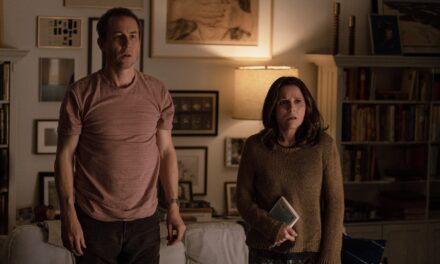
Reclusive English professor, Charlie (Brendan Fraser), a 600-pound morbidly obese gay man, struggles with an array of difficult personal challenges in director Darren Aronofsky’s latest, “The Whale.” Photo courtesy of A24.
And, no matter what Charlie does, he seems fundamentally incapable of resolving the challenges before him. It doesn’t help that he refuses to seek serious medical help, either, leading onlookers to believe that he’s simply given up on life, merely waiting for the end to come. Of course, when one considers his opinion of himself, that’s not particularly surprising; his self-esteem is virtually nonexistent, an outlook driven by a view of himself based on the assumption, “Why would anyone want to have anything to do with me?” Some might see this as wallowing in self-pity, but others would more astutely see this as a case of someone unable to address matters that are simply too big for him to handle, a view metaphorically mirrored by his immense stature.
Those closest to Charlie try to help him out, but they often look on in futility. That’s perhaps most apparent in the reactions of his friend and caregiver, Liz (Hong Chau), a nurse and the sister of his late partner. She does her best to offer care and compassion, but she often ends up frustrated over Charlie being his own worst enemy. Then there’s Thomas (Ty Simpkins), a door-to-door fundamentalist missionary who believes he was meant to show up in Charlie’s life to save his soul, a gesture he politely declines, despite his would-be savior’s repeat unsolicited visits.
The comparatively genial meetings with Liz and Thomas are more than offset by the considerably more antagonistic, cold-hearted visits from Charlie’s long-estranged teenage daughter, Ellie (Sadie Sink), whom he hasn’t seen since deserting her when she was eight years old. Ellie wonders why her dad has unexpectedly sought to resume contact with her, yet she reluctantly complies with his request, despite spewing more than her share of bile about her opinion of him and his long-ago act of abandonment. In fact, about the only thing that keeps her coming back for further visits is his promise of an inheritance meant exclusively for her, a bequest that may well be coming her way sooner rather than later given his rapidly declining health. Nevertheless, even that isn’t enough to stop her sniping, callously showering her father with unrelenting venom about his weight, his sexuality and what she sees as his innately pathetic existence.
Ellie’s sentiments are echoed by those of her mother, Mary (Samantha Morton), when she pays an unexpected visit to Charlie after hearing about his meetings with their daughter, encounters that he was hoping to keep off her radar. She’s especially upset when she learns that Charlie has compiled an impending windfall for Ellie after years of claiming that he had no money to give them in the wake of their separation. It also angers Liz given all the years of charitable care she had been so freely providing him. And this revelation is yet another reason to fill Charlie with regrets and self-loathing, further lowering his sense of self-worth. It’s almost enough to finally push him over the edge.
No matter how all of this plays out, however, Charlie recognizes the good in what these others say and do, even when their treatment is seemingly hurtful. He can see that there is concern for him in their hearts, regardless of the package in which it comes wrapped. It provides him with a sense of love, warmth and support, backhanded though their delivery may be. These are qualities that he’s been unable to provide himself, and they come at a time when he needs them most. That’s quite an insight for someone who has been the target of such relentless bullying and unbridled ridicule. We should all have such a sense of enlightened perceptiveness under conditions like these.

Liz (Hong Chau), a compassionate caregiver for a 600-pound morbidly obese gay man in poor health, worries that no matter what she does won’t be enough for him in director Darren Aronofsky’s “The Whale.” Photo courtesy of A24.
When most people look at Charlie’s circumstances (or those of other individuals like him), they frequently have two initial reactions. The first is usually “Thank God that’s not me.” And the second is often “How did he get himself into a situation like that?” I can’t speak to the first sentiment, as that’s a personal response. But, as for the second, it has to do with his beliefs, for they shape the nature of his reality. It’s not obvious whether Charlie is familiar with this mode of thinking, but the results he’s attained are a direct reflection of what he believes, particularly about himself.
Almost universally, outsiders see Charlie’s existence as pathetic. But, then, he sees himself the same way, so is it any surprise that his reality would be imbued with qualities that embody such an outlook? He hates himself, and so he has created an existence that he also hates, filled with hateful conditions and individuals who, at least superficially, appear to hate him and how he lives. He even engages (and has long engaged) in actions that validate this perspective. However, even though this viewpoint appears to be the primary thrust of his thinking, it’s not the only one that’s present in his consciousness, and those other notions also figure in to how his reality plays out.
For example, as noted earlier, there’s a part of Charlie that believes in the innate goodness in others, even if their words and deeds don’t always outwardly reflect that notion. He sees that inherent care and compassion directly mirrored back to him, for instance, in the behavior exhibited by Liz and Thomas. He also sees it in the actions and comments of Ellie and Mary, even if those underlying sentiments are drenched in anger and frustration, masking their true feelings.
Charlie’s response to their reactions, as well as to his own views of himself, are also equally convoluted and seemingly contradictory. And, given what he’s created for himself, it’s no wonder he often doesn’t know how to effectively respond to his circumstances. The conditions he’s manifested are so dire and so fraught with huge ramifications that he doesn’t know which way to turn first. Indeed, how can one successfully respond when the scenario appears to be just too big to resolve?
This is where Charlie looks to the input of others to help guide him, but that’s not always a wise practice, either, since the feedback is so blatantly contrary. Liz and Thomas, for example, try to help and give him the support he needs to work through his challenges. Ellie and Mary, meanwhile, unapologetically spread their scorn, often reflecting the widely embraced attitudes of fat-shaming and homophobia held by segments of the public at large. What is one to make of a conundrum like this?
The natural inclination for many who feel so conflicted is to want to hide, and what better way is there to do that than to bury oneself under massive layers of camouflage, like those provided by huge slabs of body fat. If Charlie doesn’t want the world to see who he is, there’s likely some part of his consciousness that wants to make a concerted effort to conceal the image of himself that he so detests. True, he may have perpetrated some acts that are far from acceptable, but it’s also obvious that heʼs an individual in a great deal of pain that he’s unable to resolve. Who wouldn’t want to hide under circumstances like these?
The fallout from that can be significant, too. The shame and embarrassment that Charlie feels make it almost impossible for him to be honest, both with himself and with others. That has to be a horrible feeling, and it may even make one question one’s worthiness of receiving the genuine kindness of others. This leaves Charlie susceptible to a continuing cycle of self-destructive beliefs and behavior, causing him to spiral ever downward into an abyss of misery from which he may never recover.

Ellie (Sadie Sink), the long-estranged teenage daughter of her 600-pound morbidly obese gay father, seeks to engage in a reluctant, angry reconciliation with him in director Darren Aronofsky’s “The Whale,” now playing theatrically. Photo by Nick Tavernise, courtesy of A24.
Can Charlie bounce back from his despair and a destiny that appears inevitable? That’s hard to say, but one thing is for sure: For him and anyone else similarly situated, it comes down to his beliefs and which ones he chooses to embrace. It’s never too late to change course, but one must have the courage, conviction and desire to do so. And, given the state of his physical and emotional condition, it’s crucial that he make up his mind soon, while he still has the time, opportunity and wherewithal to make a meaningful and impactful change. But the key question here is, “Will he do it?”
Of course, it would be tremendously helpful if others would get on board with him and offer the support and encouragement he needs. And this, if nothing else, is one of the key messages of this film, a heartfelt plea for us to provide those in need with the care and compassion they require when attempting to deal with challenges that seem patently overwhelming. Doing so may not always be easy, especially when one is tempted to give in to the kind of judgmentalism that frequently accompanies widely held beliefs about what’s acceptable in areas like body positivity and alternative sexuality (let alone in one’s view about somebody who embodies both qualities). But, on this point, we each have the capacity to choose to blindly follow the pack or to let our natural humane instincts to surface. Most of us would never think of being cruel or critical toward those suffering from the detrimental effects of substance abuse, financial difficulty or health conditions, so why would anyone do the same when it comes to addressing another’s obesity or sexual orientation?
Amazingly, I’ve been shocked by some of the hurtful reactions I’ve seen to this film from both viewers and critics. How anyone could embrace such vile viewpoints is difficult for me to fathom, let alone to make those sentiments plainly known in print or on the internet. “The Whale” genuinely pleads with us to attempt walking in the shoes of someone like Charlie to gain a greater appreciation of what individuals like him must endure. Yet, considering some of what I’ve read, it’s painfully obvious that many have missed the point of the picture – and an opportunity to learn and grow from the experience. Those are the ones who I truly feel sorry for. As a plus-sized gay male myself, I know what it’s like to be on the receiving end of such disrespectful treatment, and I can honestly say how devastatingly painful it is. No one should be subjected to such undue ridicule, especially when their name-callers have a chance to learn from films like this that show the effects their behavior have on their victims. One can only hope that they don’t miss out on an opportunity to learn such a valuable life lesson.
The old saying about glass houses and not throwing stones seems fittingly apropos here, both for the characters in this story and the ever-so-cynical critics who have so unfairly and recklessly flung their condescending assessments toward this offering. Director Darren Aronofsky’s latest tells a heartbreaking and heartwarming tale of someone attempting to resolve challenges that often seem insurmountable. At the same time, however, we also see a quietly hopeful character who somehow manages to see the best in people, despite having often been the object of cruel, unapologetic scorn and has consequently been needlessly hard on himself. It’s an outlook that many of us are unable to imagine, let alone sustain, but believing that such a benevolent attitude is our natural tendency – despite considerable seeming evidence to the contrary – is a true gift and one of the tremendous attributes of this film. Now if Charlie could only come to embrace the same view for himself.
This thoughtful, insightful picture gives us much to contemplate, reminding us to make the most of our beliefs during the short time we have in our lives. It can be a hard watch at many points during the story, emotionally grabbing and shaking viewers in getting its points across. Admittedly, there are a few segments in which the dialogue comes across as somewhat awkward and stilted (even though the rationale behind such instances ultimately becomes apparent). But this modest shortcoming is more than made up for by the film’s superb ensemble cast (arguably the best I’ve seen this year), with stellar performances by Fraser (who’s truly deserving of this year’s best actor honors) and a fine crew of supporting players, including Sink, Chau, Morton and Simpkins. The film is also noteworthy for its exemplary achievements in makeup, particularly the enormous body prosthetics created to portray the protagonist’s massive stature, special effects that required hours to apply before each day’s shoot. This moving tale is indeed designed to draw out the compassion in others; let’s just hope it does.
“The Whale” has received more than its fair share of accolades thus far, though, in my view, it’s been somewhat shortchanged for many of the big prizes in this season’s award competitions. Most notable among the honors it has received are the best actor awards and nominations Fraser has earned, winning the Critics Choice Award and capturing nominations in the Golden Globe, Screen Actors Guild, BAFTA and Academy Award competitions. Fraser’s co-star, Hong Chau, has also fared well, earning supporting actress nominations in the Critics Choice, Screen Actors Guild, BAFTA and Academy Award contests, while Sadie Sink earned a Critics Choice Award nod for best young performer. Meanwhile, screenwriter Samuel D. Hunter received Critics Choice and BAFTA nominations for his script adaptation of his 2012 stage play. And, quite fittingly, the picture also garnered Critics Choice, BAFTA and Oscar nods for best hair and makeup. The film is currently playing theatrically.
Life provides us with opportunities for taking on tremendous challenges, life lessons designed to help us grow and develop as individuals. Sometimes, though, we may bite off more than we can chew, leaving us ill equipped for overcoming what we’re presented with. Under those circumstances, we may quickly find ourselves unable to tread water, increasingly running the risk of sinking. At times like this, we need someone to throw us a lifeline to help us stay afloat, not criticism about our inability to swim. “The Whale” provides us with a cinematic analogy to that situation, one that we should all take to heart, a valuable lesson that just might help us to save a life at a time when such compassionate assistance is truly needed most.
A complete review is available by clicking here.
Winter Break Time

Photo by Anton Bogdanov, courtesy of Unsplash.com.
Those of you expecting the January movie edition of the Frankiesense & More podcast, please note that we’re taking a much-needed winter break, especially after having watched so many awards season releases! But don’t worry – we’ll be back with lots of exciting new developments! So, after we’ve had our fill of lounging by the fire in the ski lodge with tankards of hot buttered rum, we’ll return with reviews of new movies and our Oscar predictions. Stay tuned!
Breaking the Chains of Limitation
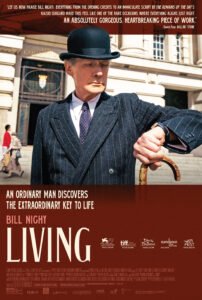
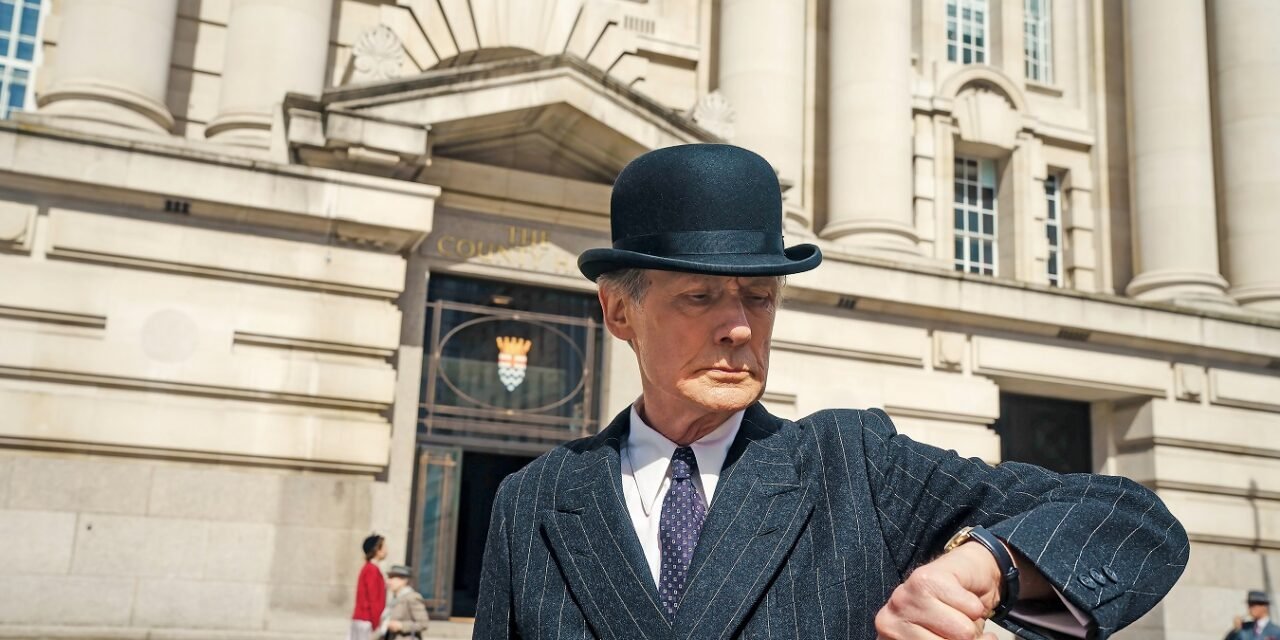
Willingly taking ourselves out of our comfort zones is something that may make many of us squirm in discomfort. As creatures of habit, we like our lives filled with familiarity and predictability. So, when we find ourselves faced with having to make adjustments in light of our conditions, we might rail against those circumstances, especially if we feel the pressure of time constraints squeezing us into unexpected (and not necessarily welcome) alterations. Those are the limitations thrust upon a long-inflexible public official whose advancing years force him into changing his life path in the endearing new drama, “Living” (web site, trailer).
Mr. Rodney Williams (Bill Nighy) has spent years perfecting the practice of turning life into an unrelenting routine. The aging, button-down civil servant for London’s Department of Public Works lives out virtually every day in the same unchanging manner, executed with impeccably clocklike precision. He seems perfectly content with following this rigid protocol. But is he really? Does his life give him satisfaction and fulfillment? Or is he merely going through the motions, oblivious to the concept that there’s more to life than reviewing work permits and abiding by the rules of an entrenched bureaucracy?
The environment in which Mr. Williams operates reflects this meticulously organized worldview, too. His daily train commute to downtown London from his home on the city’s outskirts never varies. Upon arriving at work, he dutifully extends a properly deferential greeting to his superior (Michael Cochrane), despite being routinely ignored. He then walks into his office, which resembles a fortress built from towering stacks of long-accumulated (and often-unresolved) paperwork. And, once there, he’s surrounded by a coterie of colleagues – particularly Mr. Middleton (Adrian Rawlins), Mr. Rusbridger (Hubert Burton) and Mr. Hart (Oliver Chris) – who devotedly follow through on their respective work assignments with perfunctory exactitude. It’s all so very painstakingly ordered and predictable.

Mr. Rodney Williams (Bill Nighy) leads a life of clocklike precision as a municipal bureaucrat in 1953 London in director Oliver Hermanus’s latest, “Living,” a remake of iconic Japanese filmmaker Akira Kurosawa’s 1952 classic, “Ikiru,” now playing in theaters. Photo by Ross Ferguson, courtesy of Number 9 Films and Sony Pictures Classics.
Moreover, Mr. Williams has become so accustomed to this way of life that he expects others to naturally follow suit. For example, when a trio of local community activists (Zoe Boyle, Jessica Flood, Lia Williams) approaches his department about obtaining approvals to build a neighborhood playground, he assumes they’ve attended to every last detail, a routine that has apparently been repeated with them for some time. And, if anything is missing, he doesn’t hesitate to send them on an unending wild goose chase – such as paying visits to other municipal departments – to square up any oversights, many of which invariably end up remaining incomplete or referred elsewhere. It’s frustrating for these well-meaning advocates when failure to comply with such petty details continually sidetracks them from moving forward with their project; after all, they see things like the playground as much-needed infrastructural improvements, given that the neighborhood children have no safe place to go for fun in their rundown section of 1953 London, an area that is still recovering from the devastation of World War II. But Mr. Williams sees rules as rules – and that there’s no way getting around them when it comes to ventures under his purview.
The few “aberrations” present in Mr. Williams’s world don’t seem to have much impact on him, either. This includes the influence of a pair of young associates – Miss Margaret Harris (Aimee Lou Wood), a perky, modestly effervescent colleague (and the only woman in his department) who, despite a strong career drive, understands that there’s more to life than work; and Mr. Peter Wakeling (Alex Sharp), a jovial, light-hearted new hire who has yet to be sufficiently indoctrinated into the regimen and culture of the civil service working world (and someone who also apparently has eyes for Miss Harris). Then, outside the office, there’s Mr. Williams’s ambitious, loyal, loving son, Michael (Barry Fishwick), and his thoughtful, caring daughter-in-law, Fiona (Patsy Ferran), both of whom moved in with Dad after the passing of his late wife. Michael and Fiona do their best to keep him company and to attend to his needs, though he often seems to be too preoccupied with his own thoughts and interests to pay them much attention. And, despite the sincere attempts of all these lighter spirits to reach out to him, he never seems to respond in any particularly acknowledging way.
Events take a turn, however, when Mr. Williams announces to his staff that he’ll be leaving work early one day. He’s vague about the reason, and they refrain from asking him out of respect for his privacy. But, as things turn out, it’s for an appointment to see his physician (Jonathan Keeble). And, not long after their consultation starts, the doctor reveals that the news isn’t good: Mr. Williams has late-stage cancer – and not long to live.
The diagnosis – devastating though it may be – is the first thing to get Mr. Williams’s attention in quite some time, shaking him out of his longstanding complacency. But, despite this knowledge and the profound impact it has on him, he can’t bring himself to openly discuss it with anyone, including his family, despite attempts at practicing how to deliver the news. So what’s next?

As a newcomer to the working world, Mr. Peter Wakeling (Alex Sharp, center) seeks to make his way as a neophyte civil servant in director Oliver Hermanus’s latest offering, “Living.” Photo by Jamie D. Ramsay, courtesy of Number 9 Films and Sony Pictures Classics.
Mr. Williams’s colleagues are perplexed when he fails to show up for work the next day – as well as in the days that follow. They speculate about where he might be and when he might return, but, with no awareness of what went on the day he left work early, they’re mystified about what happened and what to expect.
So where does Mr. Williams go? Quite impulsively, instead of following his usual morning routine, he boards a train to a small English seaside resort. He stops in a local café, and, while there, he strikes up an impromptu discussion with Mr. Sutherland (Tom Burke), a would-be artist who has many aspirations but little to show for his efforts given his unapologetic penchant for debauchery. In the course of this conversation, Mr. Williams at last opens up about his declining health (and ironically to a relative stranger). He also says that he would like to make the most of what time he has left. But, in the wake of this revelation, he also makes a huge admission – he doesn’t know how to do that and seeks his new acquaintance’s input.
Considering Mr. Sutherland’s inclination to always be on the lookout for a good time, he proceeds to chaperone Mr. Williams on a night of decadence at the resort’s local nightspots. They visit bars, amusement arcades and even an exotic dance revue. But, even though these are new experiences for the hitherto-conservative bureaucrat, they’re not for him. He’s looking for something more meaningful, an opportunity that will give him a chance to make a difference and leave a legacy. However, just as he admitted to Mr. Sutherland at the café, he doesn’t know how to go about this, either.
Mr. Williams attempts to arrive at an answer by reflecting on his past, particularly events that were important to him in his youth and that he hasn’t pursued much over the years as he became more preoccupied with the everyday concerns of his work routine, musings that get him thinking. He then has a chance meeting with Miss Harris one day during his absence from work. They strike up a conversation and begin spending time together on a regular basis. He helps her land a new job that she had applied for, and they begin sharing thoughts about life, what it means and how it can provide meaning for each of us. Through those encounters, Mr. Williams develops a newfound appreciation for what makes life worth living. And it gives him an idea on how he can go about leaving that legacy that has become so important to him. But will he be able to accomplish his goal with what time he has left? That remains to be seen and whether he legitimately has a chance to learn what it means to truly make life worth living.

Miss Margaret Harris (Aimee Lou Wood) serves as a source of inspiration for a dying man to make the most of what time he has left in the engaging new drama, “Living,” now playing in theaters. Photo by Ross Ferguson, courtesy of Number 9 Films and Sony Pictures Classics.
One can’t help but have some sympathy for Mr. Williams. Having spent the lion’s share of his life missing out on so much, with his head deeply buried in ledgers and rule books, many of the pleasures of existence have passed him by. However, upon closer inspection, we can see that living his life his way was his choice. He even admits at one point that his principal ambition in life was to live it as a refined gentleman. Nevertheless, noble though that it might be and harmonious as it is with the aspirations of English culture, it’s also somewhat limited. Having to constantly look over one’s shoulder and worry about saying the wrong thing or doing something that might cause offense isn’t much of a life considering all it has to offer. Perhaps a more open, less restricted approach would be preferable – and a choice that one shouldn’t wait until the end to invoke.
Choosing a broader perspective is entirely possible, provided we believe in the possibility. And that’s where the power of our thoughts, beliefs and intents come into play in manifesting the existence we experience. Given Mr. Williams’s limited worldview, it’s doubtful he’s ever heard of this school of thought and the limitless range of possibilities it makes attainable. However, considering his newfound ambition – to do something meaningful that would leave a legacy while he still has time left – there isn’t a better time for him to investigate what it has to offer and to put its principles into practice. He’s fast approaching a time when there is no tomorrow, so he’d be wise to get down to business.
Changing our existence is entirely possible thanks to our power of choice, a birthright that resides in our psyche and consciousness to which we always have access. Of course, that only happens if we’re aware of the existence of this capability, and those who have allowed themselves to become deeply entrenched in the notion that “we don’t have a choice” may not be aware of it. Thankfully, however, Mr. Williams has the presence of mind to recognize it and to make use of it, a tool that could readily prove valuable in his new endeavor.
With little experience in letting go, and being anxious to learn how to do so, he’s certainly wise to leave himself open to exploring his options, something he does eagerly by breaking his routine, asking others for help and cutting loose for his evening of unrestrained freedom with Mr. Sutherland. And, even though everything he initially tries out doesn’t work, at least he’s getting practice at loosening up that tightly buttoned-down collar. That’s a first step – and an ambitious one at that – one for which he is to be commended, no matter how much it startles or inconveniences others, including those close to him. Indeed, the first move in striking out in a new direction is to take bold steps in connection with that notion, something he certainly does.

London Public Works Department employees Mr. Rusbridger (Hubert Burton, left), Mr. Hart (Oliver Chris, center) and Mr. Middleton (Adrian Rawlins, right) begin their daily routine as dutiful civil servants in “Living,” now playing theatrically. Photo by Ross Ferguson, courtesy of Number 9 Films and Sony Pictures Classics.
Mr. Williams is also to be applauded for having the wisdom and insight into recognizing what does – and doesn’t – work for him. By employing his powers of discernment, he’s able to identify which manifestations are in line with his most heartfelt beliefs, those that harmonize with the nature of his true self, his authentic being. It’s why he’s able to quickly recognize that, despite the fun of his night of debauchery, it’s not how he wants to spend the remainder of his days, simply because that’s not who is deep down inside. He may be willing to cast off the shackles of his old life, but that doesn’t mean he’s willing to veer off into a new way of living that doesn’t align with his true persona.
That’s when he begins to explore other options, looking for those that will give him genuine satisfaction and fulfillment. He’s also wise to draw into his life those who can help guide him through that journey. His affiliation with Miss Harris, for example, provides him with a source of inspiration and a sounding board for exploring new possibilities. This is also true, to a lesser extent, with Mr. Wakeling. And, in appreciation for the assistance of these colleagues, Mr. Williams just might be able to do a little something for them. While gratitude has never been one of his particularly strong suits, he now has a chance to implement it to say thanks for his cohorts’ generosity of spirit, an opportunity to return the favor, a gesture inherently brimming with the fulfillment and satisfaction he has been searching for. If those aren’t laudable creations in the spirit of meaningful manifestation, I don’t know what are. And getting this in under the wire is even more impressive, a fine example of making the most of what temporal resources one has left.
By implementing these measures and learning the ways of this mode of thinking, Mr. Williams truly discovers that the chains of limitation can be broken and how to do so. That’s a big lesson for any of us, especially for someone who has spent his life believing that such possibilities were incapable of being realized. However, his experience lends ample credence to the notion of “better late than never,” even when it comes to learning valuable concepts about the nature and quality of existence. Well done, kind sir.
Based on the film “Ikiru” (1952) by acclaimed Japanese director Akira Kurosawa, this English adaptation of that work by South African filmmaker Oliver Hermanus faithfully re-creates the touching story presented in that picture in a setting a world apart from the original. It’s a heartbreaking yet heartwarming tale about the earnest sincerity of one determined to do good under trying circumstances and a tight timetable. While the storytelling style here may initially seem scattered, episodic and unconventional in some respects, there comes a turning point where the reasons for this become apparent, leading viewers (as well as the protagonist) to a new level of understanding in what proves to be a truly moving final act, an approach often used by Kurosawa and lovingly reproduced in this fitting cinematic homage. This is the kind of movie that will definitely appeal most to those of a certain age (i.e., those fast approaching their own finish lines), and it’s one that will almost certainly grow on audience members the further they get into it, even if it doesn’t garner widespread general appeal. The standout aspect of this production, of course, is Nighy’s stellar performance, one that has, thankfully, finally yielded ample, well-deserved recognition for this long-overlooked actor. It’s a portrayal backed by a fine supporting ensemble cast, gorgeous cinematography, and the excellent adapted screenplay of Kazuo Ishiguro, who previously distinguished himself in such works as “The Remains of the Day” (1993) and “Never Let Me Go” (2010). And don’t be surprised if this one evokes a few tears along the way, a sure sign that the inspiring and emotive message of this offering is truly getting through, successfully presenting viewers with insights into the true meaning of living.
Community activists Mrs. McMasters (Zoe Boyle, left), Mrs. Smith (Lia Williams, center) and Mrs. Porter (Jessica Flood, right) plead their case to bureaucrats to build a neighborhood playground in a war-torn section of London in the engaging new drama, “Living,” a remake of the 1952 Japanese classic, “Ikiru.” Photo by Ross Ferguson, courtesy of Number 9 Films and Sony Pictures Classics.
Even though “Living” is one of the late comers among awards season releases, it’s nonetheless well worth the viewing time, and it has earned its share of well-deserved recognition. That’s particularly true for Nighy’s superb performance, capturing best actor nominations in the Golden Globe, Critics Choice, Screen Actors Guild, BAFTA and Academy Award competitions. Its excellent adapted screenplay also earned the picture Critics Choice, BAFTA and Oscar nominations, as well as a BAFTA Award nod for Best British Film. And the National Board of Review has generously selected “Living” as one of its Top 10 Independent Films of 2022. The film is currently playing theatrically.
One of my all-time favorite movie lines was poignantly delivered by Rosalind Russell in her outstanding portrayal of the title character in the film classic “Auntie Mame” (1958): “Life is a banquet and most poor suckers are starving to death!” That line could readily be used to describe the profoundly stagnant existence of Mr. Rodney Williams. Fortunately, though, with inspired insights not unlike those taught by Ms. Russell, the beleaguered protagonist of this offering catches on to the wisdom of that sentiment and makes use of it to transform himself, his life and his legacy. We should all be so wise to do the same for ourselves before the clock runs out. To do any less is to dishonor ourselves, our existence and our contributions to living.
A complete review is available by clicking here.
What Makes a Family?

When we think of the concept of “family,” we most often consider it as something made up of those with whom we’re developed our closest bonds. This has traditionally been built on a basis of biology, but, over time, we’ve seen that change. And, in some cases, it’s become something that may arise as a result of unexpected circumstances, sometimes exceedingly unfathomable ones. So it is in the delightfully new quirky Korean comedy-drama, “Broker” (“Beurokeo”) (web site, trailer).
Baby Woo-sung (Ji-yong Park) is about to embark on a grand adventure, even if he is unaware of it and doesn’t understand or appreciate the impact it will have on him and his future. Late one rainy night, the boy’s mother, So-young (Ji-eun Lee), approaches a church that’s been equipped with a “baby box,” a secure depository where the parents of infants who are unable or unwilling to care for their young can safely leave their children in the hands of those who will nurture and protect them until they’re ready to be put up for adoption. But, just as she’s about to hand over her son, So-young hesitates, placing Woo-sung on the ground just outside the box, exposed to the elements, at which point she simply walks away. And, ironically, she leaves him with a note pinned to his clothes saying not to worry, that she’ll be back for him. Clearly the young mother is torn about what to do.
Even more interesting is the fact that the incident is not without witnesses. As the events play out, two officials from Child Protective Services watch from their stakeout as the youngster is abandoned. The chief of this operation, Sgt. Soo-jin (Doona Bae), looks on in quietly angry dismay, wondering how anyone could possibly desert a child in such a cold, callous way by not even following through on the proper transfer procedure. Soo-jin and her associate, Det. Lee (Lee Joo-young), approach the baby box, lifting the child off the ground and placing him inside the secure chamber, out of the elements. They take comfort in having done right by Woo-sung, though Soo-jin looks on with some remorse: As a married but childless woman, she exhibits a sadness at not being able to step up and do more for the infant – and for herself.
However, even though the child was safely placed in the baby box, things aren’t exactly on the up and up, part of the reason why the CPS officers have been surveilling the site. It’s believed that the box has been used as a source of obtaining children for an illegal baby brokerage operation run by Sang-hyeon (Song Kang-ho), the owner of a dry cleaning/tailor shop, and his sidekick, Dong-soo (Dong-won Gang), a former athlete who was himself abandoned and spent much of his childhood in an orphanage. But, if Soo-jin and Det. Lee hope to obtain a conviction against the brokers, they must catch the perpetrators in the act of selling a child, something they hope to be able to do if Woo-sung were to go on the market.
The situation is further complicated by additional extenuating circumstances. When So-young has a change of heart about her decision, she goes in search of the child, an undertaking that eventually leads her to the brokers. She attempts to get her son back, but the brokers tell her that she relinquished that option when the child was placed into the baby box, something she denies doing. That revelation gets their attention, raising their suspicions that there’s something fishy going on. They decide that, unless So-young can afford to buy back the infant, they need to make a sale as soon as possible to divest themselves of the evidence. They even agree to give the mother a cut of the sale price in exchange for her assistance in helping to expedite the transaction.

Korean black market baby brokers Sang-hyeon (Song Kang-ho, right) and Dong-soo (Dong-won Gang, center) await would-be buyers for Woo-sung (Ji-yong Park, in Sang-hyeon’s arms), the child of So-young (Ji-eun Lee, left), in director Hirokazu Kore-eda’s new comedy-drama, “Broker” (“Beurokeo”), now playing theatrically. Photo courtesy of Neon.
Clandestinely disposing of the evidence is not the only consideration, either. Sang-hyeon owes money to a local mobster, Shin Tae-ho (Ryu Kyong-soo), who’s putting the squeeze on him, and he needs to generate cash quickly if he hopes to retain his limbs. What’s more, questions begin to surface about So-young’s indecisiveness regarding the handling of Woo-sung’s disposition. It becomes apparent that there’s more going on with her than ambivalence about her resolve to remain the child’s caregiver. Motherly love, it seems, has taken a back seat in this scenario.
When Sang-hyeon and Dong-soo learn of a potential buyer for the baby – an out-of-town married couple – they hit the road with So-young and the child to complete the deal, with the CPS officers in silent pursuit. However, when the prospective parents renege on the price, the deal is off, and the trio of sellers is off to find a new purchaser. Thus begins the extended road trip of this unlikely band of black market entrepreneurs, a journey filled with twists, turns and a surprising amount of humor. But, as they experience an array of dramatic and comedic adventures amongst themselves, with authorities and the mob hot on their tail, with an assortment of new would-be buyers waiting in the wings, and with an unexpected tag-along guest, Hae-jin (Seung-soo Im), a young stowaway from an orphanage, they unwittingly form a de facto family of sorts, one that may not be so easily disbanded, even if a suitable home is found for the baby. Of course, with so much pressure being placed on them (including now from police investigating their possible connection to a grisly murder), they find it increasingly difficult just to stay ahead of everyone who’s after them. Indeed, who would have thought a baby could create so much havoc?
But, then, the baby creates more than havoc in this story. He essentially helps to create an alternative family, one made up of individuals who have all been on their own for long stretches of time, quietly searching for more for themselves, even if they haven’t consciously recognized that desire until they suddenly found themselves in the midst of it. Woo-sung may have provided the focal point behind this intriguing manifestation, but it’s a materialization that has been brought about by the thoughts, beliefs and intents of his newfound kindreds. This is the essence of how we bring about the reality we experience through the power of these intangible resources. Woo-sung’s new “relatives” may not be aware of this school of thought or even the unrecognized, unrealized intentions lurking in their consciousness. Yet it’s quite something to see how their long-submerged wishes find a way to surface and materialize as they do here.
Granted, that outcome may not have been what these characters thought they had in mind when this adventure began. But its creation shows just how powerful our beliefs are, how they can push through to the surface, even when prevailing conditions – such as the pursuit by authorities and the mob, as well as other considerations – might well suggest otherwise. Indeed, life’s “surprises” can truly be pleasant, especially when “unexpected.”
Of course, no one here could likely pull this off individually, but the pooled belief resources of all involved can work wonders when the collaborators operate collectively. Woo-sung has a group of caregivers dutifully looking after him, even if their intentions toward him are initially different from how circumstances eventually pan out. Sang-hyeon, who has long been on his own, has a group of supportive kindreds around him. Dong-soo, who grew up without a family in the orphanage, now has what he had always been looking for, a sentiment now echoed in Hae-jin’s experience. And So-young, who has been on the fence about family and motherhood, finds that the idea may be more agreeable with her than she thought. Even the intrepid pursuers in this scenario may end up pleasantly surprised with what they reap.
What’s most important to recognize here is the concept of “family” and what constitutes it. We have long thought of it as a notion governed by blood, but, in recent years, we’ve seen that change to one shaped more by relationships, regardless of whether biology is involved, a point once again reinforced here. This is not to suggest that peddling in black market babies is a recommended way to bring that about. However, the circumstances in this story illustrate that even the seemingly unlikeliest of situations can lead to what we desire, including the formation of a family. This is a theme that’s become prevalent of late in such films as “The Inspection.” It’s also a subject that director Hirokazu Kore-eda has explored in several of his previous movies, such as “Shoplifters” (“Manbiki Kazoku”) (2018) and, to a lesser extent, “The Truth” (“La verité”) (2019), both of which involved stories where individuals from disparate (i.e., largely nonbiological) backgrounds were drawn together into familial units through unconventional (i.e., sometimes unsavory) circumstances. Indeed, we often never know what we’re going to get until events begin to unfold – and frequently in surprisingly amenable ways.
When we look to get the best out of life for ourselves, we often need to “broker” a deal to fulfill that goal. Which is precisely what an unlikely group of seemingly unrelated happiness seekers do in this heartbreaking and heartwarming new comedy-drama. While the film initially hooks viewers with a scenario involving a literal interpretation of the word that comprises its title, it skillfully moves on to explore how we attempt to get what we want out of life by brokering circumstances to our advantage, in this case the realization of long-held quietly cherished desires. In taking this unexpected turn, the story shows how such endeavors can have both their dubious qualities, as well as heartfelt, sincere intentions (their inherently questionable actions and manipulative practices notwithstanding). The filmmaker accomplishes this by deftly weaving gentle humor, genuine emotion and a moving soundtrack into the narrative, taking the edge off the primary troubling story thread and adding a sense of warmth that tenderly humanizes the picture’s overall direction. Thus what may be perceived beforehand as a dark and sinister tale tactfully guides audiences down a different (and heart-tugging) path. This is perhaps one of Kore-eda’s best and most personal offerings, featuring a well-crafted script and what is arguably a cast of Korean all-stars who deliver touching and delightful performances. There are admittedly a few points in the picture where the pacing sags a bit, but they’re more than compensated for by its many strengths, making for a surprisingly satisfying watch, one of the most enjoyable releases of 2022, one that earned the picture the Cannes Film Festival’s best actor award for Song Kang-ho, the event’s Ecumenical Jury Prize, and a nomination for the Palme d’Or, the festival’s highest honor. The film is currently playing theatrically.
It’s funny how life sometimes starts us down one path but then takes us in a completely different direction. We may be surprised by where we end up, but it might also be more satisfying than where we initially thought we were headed. The question, of course, is what do we do when we arrive at that unexpected destination? Do we struggle to get back on our original path? Or do we embrace what we’ve wrought for what it is? If we’ve brokered what we really want, why question it? That can be particularly crucial when it comes to building the family we want, at last achieving the sense of belonging we’ve always sought. Indeed, what more could we ask for out of a family?
A complete review is available by clicking here.
Copyright © 2022-2023, by Brent Marchant. All rights reserved.




Recent Comments