
Matching Wits with Disempowerment

Anyone who has ever been on the receiving end of a bully’s wrath can understand the hurt, anxiety and self-esteem issues that frequently accompany such physical and emotional trauma. The abusive taunting, teasing, mockery and ostracism that come with such cruel treatment can leave its victims devastated for years afterward, making it difficult, if not impossible, to recover. And this doesn’t even account for the awkwardness that the abused go through in seeking to assimilate into society and its everyday course of conduct. However, such incidents – as painful as they can be – frequently lead to valuable life lessons in empowerment and overcoming adversity, despite the seemingly insurmountable odds stacked against their targets. Those are among the important teachings to emerge in the new coming of age drama, “The Plague” (web site, trailer).
Summer camp is supposed to be one of those memorable, fun-filled youthful rites of passage that stays with us for a lifetime. At least that’s what 12-year-old Ben (Everett Blunck) hopes for. The reserved, somewhat geeky tweener looks forward to a fulfilling experience at water polo camp. But he’s looking for more than just learning how to become an accomplished athlete and the principles of honorable sportsmanship. He’s also anxious for pointers on how to fit in better, not just as a team player, but also in everyday social situations. Of course, if he’s to do that, he needs to shed some of his shyness and naivete and brush up his sense of street wisdom, something that he’d like to hope comes with hanging out with a bunch of peers his age, to become one of the guys. And he gets that wish when practice begins. In no time, Ben is making solid friendships with about a half dozen of his fellow campers. Or at least that’s what he’d like to think.

Reserved, naïve tweener Ben (Everett Blunck, center) looks forward to a happy summertime water polo camp experience but gets more than he bargained for in the new coming of age drama, “The Plague,” now playing theatrically and soon available for streaming. Photo courtesy of Steven Breckon and IFC Films.
Ben’s circle of friends is led by a wise-cracking alpha male, Jake (Kayo Martin), who seems to know all the angles. Jake recognizes that Ben sometimes lags a little behind the others when it comes to street smarts, but he likes him and takes him under his wing, as if he were a life mentor of sorts. Ben doesn’t always catch on to things quickly, but he’s earnest in his intent, with an eagerness to assimilate. And, if he sees something that doesn’t seem quite right or that he doesn’t immediately understand, he’s not one to automatically dismiss it out of hand; he gives the experience a chance to sink in and percolate for a while as he assesses matters and makes up his mind, usually in favor of whatever his peers are proposing.
However, Ben’s sense of social fair play gets put to the test when he learns about “the plague.” As it turns out, a sinister, allegedly fact-based legend underlies camp culture that has been perpetuated over time. When Ben first hears of it, he’s naturally oblivious to it, so Jake and the others clue him in. In essence, the plague is said to be a highly contagious illness spread by physical contact. It begins with a severe, widespread skin rash that degenerates into an array of other debilitating symptoms, eventually culminating in madness and an almost zombie-like compulsion to spread the disease to others, as if the carriers were looking to recruit unwitting converts. Those who are afflicted are to be avoided – shunned, in fact – at all costs to prevent transmission. And Ben learns about this when he sees his compadres going out of their way to flee the company of one of their fellow campers, Eli (Kenny Rasmussen), who’s said to be a plague victim.
At first, Ben doesn’t know what to make of the claims about the plague. He’s initially cautious, especially when he sees Eli’s torso covered in big, red blotchy patches, but he’s also full of doubts about the veracity of his peers’ contentions. In essence, he’s not sure what to believe. But that changes when Ben has a one-on-one encounter with Eli in the locker room. They converse, and, through their dialogue, Ben can see that Eli is something of a nonconformist, an original thinker full of creative and atypical ideas for most guys his age. But Ben can’t help but ask himself, “Is he the ‘monster’ everyone is making him out to be, just because he has a nagging skin rash and embraces a range of different sensibilities?” This leads Ben to think that Jake and the others are treating Eli unfairly – and that there’s no such thing as the plague, that it’s merely a pretext made up to ostracize those who don’t comply with expected attitudes and behaviors. As a consequence, Ben actually begins defending Eli as someone who’s simply misunderstood and has trouble fitting in, circumstances to which Ben can relate all too well.

Water polo camp participant Ben (Everett Blunck, left) confides with his coach (Joel Edgerton, right) about more than sports in writer-director Charlie Polinger’s debut feature, the coming of age drama, “The Plague.” Photo courtesy of Steven Breckon and IFC Films.
Because of this, Jake and the others soon grow suspicious of Ben’s new behavior. They’re uncomfortable with his sympathizing toward the target victim. And that skepticism is sufficiently ramped up when Ben develops a stubborn skin rash much like what Eli’s experiencing. Almost immediately, he, too, is labeled a plague carrier (never mind the fact that skin rashes are not uncommon among those in athletic situations). Ben is subsequently treated much the same way – if not worse – as Eli. And, as a sensitive soul, he’s devastated just when he thought he had been making some progress toward learning how to blend in better. So much for the happy summertime camp experience.
Fortunately, Ben has an ally in his corner when he confides his circumstances to his coach, who’s clandestinely referred to behind his back as “Daddy Wags” (Joel Edgerton). Coach tells Ben about comparable treatment and experiences that he underwent when he was younger, circumstances that even carried on into his twenties, but that they eventually sorted themselves out when he discovered how to be himself. Those empowering words of wisdom carry a lot of weight with Ben, insights that he embraces and puts to use in combatting the effects of “the plague.”
How matters will play out, however, depends on what Ben believes, as our beliefs play a central role in shaping the nature of the reality we experience, the philosophy that produces such outcomes. It’s unclear whether Ben has ever heard of this way of thinking, but, based on how events unfold – both before and after his pep talk with the coach – it’s easy to see how the young man’s experiences materialize as they do, for better or worse. That’s particularly true when he allows doubt to creep into the picture, since doubt – a belief in itself – can undercut whatever progress Ben makes (or hopes to make) in coming to discover himself and his ability to fit in. Indeed, maybe that was the purpose behind his enrollment in summer camp in the first place – to learn valuable life lessons like this, teachings that will ultimately be more important to him in the long run than learning how to be a better water polo player.
In assessing the belief options open to him, Ben has several factors in his favor. For instance, he appears to be remarkably open-minded, which provides him with flexibility and a sense of expansiveness in his thinking when deciding which notions to embrace. This, in turn, makes it possible to consider a potentially wider range of beliefs than his peers, many of whom seem to believe that compliance and conformity are more expedient and better guaranteed routes to social acceptance. If they’re willing to blindly concur with Jake’s fabrications, the more likely it is that they will be welcomed into his circle of friends. But is that a goal to which one should aspire?

Alleged plague carrier Eli (Kenny Rasmussen) feels the harsh effects of being shunned by his peers at a summertime water polo camp in “The Plague.” Photo courtesy of Steven Breckon and IFC Films.
Ben’s beliefs make him somewhat more skeptical, especially when the claims begin to take on a more implausible nature. For example, he appears to grasp the idea that, if there truly is a plague affecting the camp – a type of malady that typically impacts a wide swath of a community or constituency – then why does it appear to be afflicting only one person in this case? And, coincidentally, isn’t it curious that it only seems to be affecting someone who’s unwilling to become part of “the tribe,” a nonconformist, who’s purposely shunned by the majority for doing so? Is that fair? And, consequently, isn’t the means employed to bring about his ostracism inherently suspect and terribly cruel?
Based on Ben’s response, his conclusion would seem to bear that out. He reaches that decision thanks to his belief in discernment, a willingness to question the prevailing wisdom if it doesn’t fit his sensibilities. As someone who appears to have a strong belief in compassion and understanding, he sees through the lies and pretense that are being mercilessly inflicted on Eli, and he refuses to go along with it. Regrettably, his defiance subsequently gets him in trouble, a form of guilt by association backlash thrust upon him because of his overtures to befriend and assuage Eli’s feelings. Before long, Ben, too, becomes “plagued” by the uncalled-for treatment of his so-called friends.
As noted earlier, Ben came into this experience hoping that it would help him to learn lessons on how to better fit in and be more readily accepted. However, in the process, he ends up learning other, arguably more important lessons, such as the value in being oneself, despite prevailing peer pressure, an insight that he gleans from his interaction with his coach and, ironically, by extension, from Eli. And, when he becomes aware of these notions, he runs with them, embracing them enthusiastically. Doing so enables him to overcome much of his crippling self-doubt and to zealously adhere to the principles of personal empowerment. He’s able to peel back the façade of wayward beliefs that have kept him from seeing the truth about himself and those who would seek to lead him astray by patently false assertions.

Wise-cracking alpha male Jake (Kayo Martin) shares insights with his peers about “the plague,” a legendary infectious disease that has long afflicted attendees at a summertime water polo camp and resulted in rigid, pervasive ostracism against its carriers, as seen in writer-director Charlie Polinger’s gripping debut feature, “The Plague.” Photo courtesy of Steven Breckon and IFC Films.
Once Ben learns how to combine the effects of all of these newfound beliefs, he’s thus able to put them to use for a greater good – taking on the bullies and giving them a taste of their own medicine (indeed, payback can be a bitch, even for someone of such a tender age). He’s also able to draw upon these lessons in inspiring Eli to change his circumstances, too – to freely and fearlessly live his own life without worries about retribution, ridicule, scorn and marginalization. That’s quite a transformation for someone who came to camp to learn about water polo.
Ben’s ability to carry out this new mission is significant to his understanding of himself. He receives a powerful lesson in the practice of value fulfillment, the concept related to being his best, truest self for the betterment of himself and those around him. There’s a laudable nobility in carrying out this aim, one reflective of who he truly is on the inside. Indeed, beliefs can work magic, even when borne out of seemingly intolerable situations. But, when we learn how to overcome these obstacles and to vanquish the demons that potentially hold us back, we can work wonders for ourselves and others, a scenario in which we no longer need be hampered by disempowerment and other traits that hold us back.
Bullying and calculated ostracism have been around seemingly forever, but, in recent years, such antisocial behavior has increasingly been receiving the disparaging attention it truly deserves. Interestingly, the latest voice added to that welcome chorus of criticism comes from this somewhat unlikely cinematic source, this excellent and insightful debut feature film from writer-director Charlie Polinger. Through this psychological/sociological thriller, viewers witness how these demoralizing influences can be effectively dispelled through the power of our beliefs and the actions we take as a result of them, initiatives that bolster our personal power and self-esteem in ways that allow us to achieve what may have once seemed wholly impossible. Idealism, compassion and consideration can truly accomplish much.
What makes this story work so effectively is the filmmaker’s skillful handling of the material, treating it almost as if it were constructed like a smart horror film – in many ways more chilling than a picture that needs to resort to gratuitous gore and excessive sensationalism to generate viewer gasps and frights (in this case, particularly at times when Ben’s initial unresolved doubts make it look like the plague could actually be real and not just the fallout of menacing mind games of a bunch of teenage boys). This approach is significantly enhanced by the picture’s atmospheric score and inventive cinematography, adding a macabre undercurrent to an otherwise-formulaic coming of age drama. Admittedly, there are times early on when the script could stand to be a little more sharply focused, but then that could also be chalked up to a reflection of the overwhelming confusion Ben experiences as he seeks to assimilate into this new, and sometimes-disturbing, environment. Some might also legitimately view this tale as somewhat clichéd at times, but the picture’s message truly can’t be overemphasized enough, especially for anyone who has ever been in on the receiving end of such reprehensible treatment.

When Ben (Everett Blunck, standing, right) is suspected of having become a carrier of the plague, he experiences the relentless ostracism thrust upon its alleged victims in writer-director Charlie Polinger’s debut feature, “The Plague.” Photo courtesy of Steven Breckon and IFC Films.
As this twice-nominated Cannes Film Festival offering so effectively illustrates, there’s no place in this world for this kind of behavior – no matter what environment is involved – and the film drives home that point with razor-sharp clarity, purpose and a mission to prevent it from continuing to impact us all. In large part this is driven home by the superb performances of the fine ensemble cast, particularly Blunck, a Critics Choice Award candidate for best young actor and an Independent Spirit Award nominee for best lead performance, and Martin, an Independent Spirit Award nominee for best breakthrough performance. In addition, the picture is a well-deserved recipient of an Independent Spirit Award nod for best feature. The film is available for streaming online.
As someone who experienced frequent bullying firsthand in my own youth, I can attest to the living hell it can be. How I wish I had known how to deploy my beliefs to counteract such treatment at the time. But, had it not been for those experiences, I also may have never learned the lessons associated with overcoming self-doubt and disempowerment to improve my circumstances. In a strange sort of way, then, I suppose I should be grateful for being shown the way to those teachings. However, knowing now that we can use our beliefs in myriad ways to accomplish our goals, I’d like to think I’d choose an easier, less drastic way to problem solving in future scenarios. Let’s hope we can all find our way to that same conclusion.
A complete review is available by clicking here.
Windie Award Winners Announced

“Sinners,” the smart horror blockbuster released in early 2025, took top honors at the Ninth Windie Awards ceremony, the annual awards program of Chicago Indie Critics, held January 15 at Chicago’s Blue Bayou Restaurant. In all, the film won 10 awards, including best studio film, best actor and best director, among other honors.
Winners were determined based on three rounds of voting by members of the organization (yours truly included). A complete list of the nominees on which the winners were voted is available by clicking here.
In addition to the 26 artistic and technical categories, CIC presented its annual Impact Award to Michael Phillips, former film critic of The Chicago Tribune. The award is given to an individual or organization in recognition of outstanding efforts that have had a positive influence on the Chicago area film community. Mr. Phillips frequently appeared on At the Movies with Ebert and Roeper from 2006 through 2008 before becoming a semi-regular host shortly before Roeper and Ebert ended their association with the series. He has also introduced over 100 feature films for Turner Classic Movies (TCM) over the years.
A complete winners list appears here. And a video recording of the awards ceremony is available by clicking here.
The Best and Worst of 2025

With 2025 now in the books, it’s time to look back on the year in movies. So what did I think of the year’s releases? Find out which pictures came up winners and losers in my view in two blog posts on my web site, “The Best of 2025” and “The Worst of 2025.” In each of these blogs, I spotlight my Top (and Bottom) 10 Films of 2025, followed by 10 Honorable (and Dishonorable) Mentions and an open-ended list (in alphabetical order) of other releases that I found noteworthy (or disappointing) or worth a look (or skippable). As much as possible, I’ve included web site and trailer links, as well as links to my own reviews.
In a separate blog post yet to be published, I will examine the Best and Worst in 2025 Documentaries. Watch my web site for this new entry to be published soon.
So, with all that said, check out what I thought about 2025’s crop of movies, for better or worse. You may not agree with me, and I respect your opinions, regardless of whether our views align. I hope you’ll respectfully grant me the same. And your feedback, as always, is welcome.
Celebrating the Joy and Power of Creation

One of the most inspiring messages I’ve run across in my life maintains that “The greatest joy is in creation,” a message that, ironically, came my way via a Chinese fortune cookie just as I had begun work on my first book. The timing couldn’t have been better, as this sentiment fed directly and abundantly into my writing. It proved to me at the time – and ever since – that creativity is essential to help keep us feeling young, fulfilled, prolific and vital. And, not surprisingly, that notion has also been crucial in the lives and well-being of a remarkable group of seniors who reside in a truly special retirement community in Milan, Italy, one that celebrates the joy and power of creation and what those qualities can do to help sustain – and even revitalize –.them and us. These talented individuals serve as inspiring role models not only for their peers, but also for anyone in need of rejuvenation in their lives, as illustrated in the uplifting new documentary, “Viva Verdi!” (web site, trailer).
In 1890, famed Italian composer Giuseppe Verdi (1813-1901) embarked on a philanthropic undertaking that he would ultimately call his greatest accomplishment, bigger than any of the grand, legendary operas for which he became renowned. Having attained tremendous material success from his many storied works, he wanted to give something back to those who helped him attain his fame and fortune. In particular, he wanted to recognize the contributions of the musicians who brought his compositions to life, especially those who faced financial uncertainty in retirement. At the time, there were no old age pensions for retired artists, so those individuals often had no fiscal safety nets in place to protect them at a point in their lives where they likely needed assistance most.

Baritone Claudio Giombi, a resident of the Casa Verdi retirement community in Milan, Italy, enjoys his golden years immersed in his art and serving as a mentor to up-and-coming performers, as seen in the uplifting new documentary, “Viva Verdi!” Photo courtesy of Viva Verdi.
To that end, Verdi decided to finance the construction of a retirement community for musicians in need during their golden years. But he wanted the facility to be more than just a roof over their heads. He wanted it to be a place where these musicians could live in a setting with a high quality of life, a sanctuary where residents could still be immersed in their music, both as performers for their peers and the public at large and as mentors to aspiring music students. Not only would this allow these retirees to continue to enjoy their driving passion, but it would also give them a sense of purpose and usefulness in practicing their art and in shepherding new generations of musicians into a life of enduring creativity.
Such is how Casa di Riposo per Musicisti (a.k.a. Casa Verdi) was born. Construction began in 1896 and was completed two years later, though no one occupied the facility until 1902, a year after its benefactor’s death. In its nearly 125 years of operation, Casa Verdi has been home to more than 1,000 “guests” representing practitioners of an array of musical genres, not just opera singers. Given the facility’s mission, it’s often considered a sort of “living museum,” one where the musical arts are celebrated by residents as performers and teachers while providing them with a comfortable, supportive place to call home. Today Casa Verdi houses residents aged 77 to 103, with a full range of performance and mentoring opportunities and a wide range of artistic and recreational activities, not just those specifically tied to music. In a sense, then, this geriatric artists’ sanctuary resembles the musicians’ retirement community depicted in the narrative feature “Quartet” (2012), a haven that provides more than just basic shelter.
Casa Verdi has thus more than lived up to its multifaceted mission. It has provided its residents with a venue in which they are made to feel vital as artists and instructors. They’re able to enjoy their craft and the company of their peers and to share their talents with appreciative followers while not having to worry about their material needs. Those are important considerations for individuals at this stage of life, to make the most of what time they have left, especially in the face of the ever-present conditions of declining physical and mental health. This is an inescapable fact of life for residents, as evidenced by the passing of some of those profiled in this offering who have passed on since filming on the production finished. Nevertheless, Casa Verdi has given – and continues to give – its live-in guests what they need most at a time when those needs are arguably greatest.
Writer-director Yvonne Russo delivers an engaging and intimate portrait of this inspirational venue. In addition to depicting the diversity and richness of daily life in this facility, the film profiles a cross-section of its colorful residents, such as eccentric, jovial baritone Claudio Giombi, one of Casa Verdi’s more prominent residents and a mentor to aspiring musicians like tenor Massimiliano D’Antonio; pianist and soprano Chitose Matsumoto, a transplant from Tokyo who relocated to Milan to learn how to sing Italian opera in hopes of enabling her to expand her repertoire beyond just performances of Giacomo Puccini’s Madame Butterfly; jazz drummer Leonello Biondi, who, at age 77, describes himself as one of the facility’s “kids”; 91-year-old violinist Tina Aliprandi, who still handles a bow as skillfully and fiercely as someone many years her junior; and soprano Lina Vasta, who describes herself as “ageless” and sports an impressive vocal range as a performer and singing coach. Viewers hear their captivating stories while learning much about their outlook on life, the value of art and music, and the importance of places like Casa Verdi.

Violinist Tina Aliprandi demonstrates her mastery of the bow in director Yvonne Russo’s new Oscar-nominated documentary, “Viva Verdi!”, now available for streaming online. Photo courtesy of Viva Verdi.
None of this would have been possible, however, were it not for the vision of someone like Maestro Verdi himself. He was able to picture the founding of a facility such as this at a time when they were virtually nonexistent and the beneficiaries of his generosity were typically (and unceremoniously) left to go without. However, he believed in the possibility of being able to establish a sanctuary like this and to enable bringing it into being. That was quite an accomplishment for the time, but it also set in motion a movement that helped to make comparable facilities more of a reality in subsequent years.
The key in making this happen is attributable to Verdi’s beliefs, for they play a central role in the manifestation of one’s existence. It’s unlikely that Verdi ever heard of this school of thought, but, based on what he achieved, it’s apparent that he had a grasp of its inherent principles to make things happen, particularly those of a nature that pushes the envelope of conventional thinking and perceived limitations. That’s worth noting for anyone looking to try the untried, to transform intangible concepts into tangible results, especially where they enable the fulfillment of needs that have gone unaddressed.
Verdi’s vision clearly operated on multiple levels. His beliefs in founding this facility helped to meet the practical, everyday needs of its residents for their material considerations, as well as facilitating access to the means for their continued artistic fulfillment. It also provided them with an outlet to further the education of budding musicians, enabling the perpetuation of their art in a new generation of performers. And, as for the performance aspect of Casa Verdi, it gave the public a venue where they could enjoy the talents of its residents. Consequently, the concurrent emergence of these various materializations illustrates the power of effective collaboration, of a shared co-creation in which the manifesting beliefs of all of its participating parties work together to contribute to the realization of this finished outcome. Indeed, in a scenario like this, it’s easy to see how everyone wins.
The specifics of the underlying beliefs behind a venture like this play a crucial role in the customized nature of the final product. For example, as noted in the film, at one point during Casa Verdi’s planning, the composer noted that an architect’s drawing referred to the facility as “a nursing home,” a label to which he strongly objected. “Nursing home,” he observed, implied a place for those in ill health, a conception decidedly not in line with his vision. Verdi insisted that it instead be termed “a retirement home,” one that carried connotations beyond infirmity. In his view, Casa Verdi was to be a place where residents could enjoy their sunset years, a time characterized by robust health, artistic fulfillment and personal satisfaction, not a place where one simply goes to die.
In line with that thinking, Casa Verdi has come to be place that puts tremendous emphasis on personal well-being, the idea that it’s a place where one can promote sound mental and physical health, with art and music playing a key role in attaining that goal. According to Managing Director Ferdinando Dani, that’s an especially important consideration in a facility where a number of residents are afflicted with conditions like Alzheimer’s Disease and other forms of dementia. To that end, then, Casa Verdi has become an ardent supporter and practitioner of treatment programs like music therapy, an initiative aimed at bolstering residents’ cognitive abilities through the intentional repetition of tonal patterns that help to promote familiarity, recognition and retention. It’s a treatment perfectly suited to musicians, who are naturally accustomed to recognizing such recurring patterns, not to mention one that they find enjoyable, too, particularly when employed in groups. It’s also another example of a creation made tangible by beliefs in the possibility of expanding limits and bringing them into being.
Given how long Casa Verdi has been in existence and the impressive results it has achieved, it’s a testament to its founder’s vision, one that has materialized in multiple ways and for multiple generations, including with significant intergenerational impact. To a great degree, this is attributable to the combined, collaborative beliefs of so many individuals operating in so many different but complementary and coordinated regards, yet another example of an effectively implemented co-creation. To be sure, not everyone involved in this venture may recognize their connections to one another in this joint effort, but they have nonetheless played valuable synchronized roles in a scenario driven by the concept of value fulfillment, the principle of being one’s best, truest self for the betterment of oneself and those around us, in this case on a collective basis. It’s a truly inspiring and uplifting idea that, in principle, could be put to use in countless undertakings if we were to put our minds to them. Imagine what it might be like to live life in a world where that approach was applied to more aspects of our everyday existence than in just isolated examples such as this. We might all lead more meaningful, enjoyable and fulfilling lives than many of us do now. Maybe more of us should consider looking to the maestro’s wisdom, insight and vision to help set us on the right course.

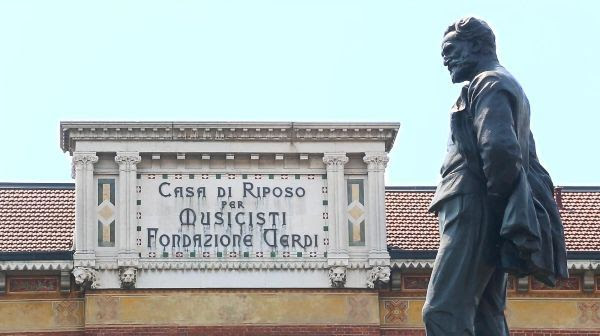
With a statue honoring founding benefactor Giuseppe Verdi (1813-1901) steps from its entrance, the Casa Verdi retirement community for aging musicians in Milan, Italy has served as an artistic sanctuary for retirees in need of financial and housing assistance, as profiled in director Yvonne Russo’s superb new documentary, “Viva Verdi!”, now available for streaming online. Photo courtesy of Viva Verdi.
Casa Verdi is indeed a noteworthy facility, one that pursues – and meets – a variety of goals, one that simultaneously supports the arts and the well-being of its in-house practitioners. At a time when many of the elderly peers of these individuals might otherwise be winding down and withdrawing from life, Casa Verdi enables its residents to feel useful, inspired, and, above all, youthful (age notwithstanding). In this captivating documentary, the filmmaker takes viewers inside this artistic sanctuary, showing how it has imbued its musical family with a sense of renewal. And, in so doing, the facility thus validates the sentiment noted at the outset above, particularly for those approaching the end of their lives, giving them purpose and joy for the time they have left, especially when it comes to that all-important notion.
Because of Casa Verdi’s success in these endeavors, this cinematic chronicle of that effort makes “Viva Verdi!” one of the most uplifting pictures that I have seen in some time. In fact, if I had any complaint at all, it would be that I wish it had been longer than its 1:18:00 runtime. The residents’ stories and performances (both archival and in the film itself) are rich, colorful and fulfilling, brimming with a sense of genuine pride and pleasure, rewarding experiences that have given them (and, by extension, us) tremendous satisfaction, enjoyment and fulfillment. The picture has even earned an Oscar nomination for best original song, “Sweet Dreams of Joy,” a moving piece written by composer Nicholas Pike and performed by soprano Ana María Martinez, which can be heard playing over the closing credits. The film is available for streaming online.
Fans of opera and fine arts truly owe much to the creatives featured in this film. But they and we also need to thank Maestro Verdi for his foresight and generosity in founding the institution that so deservingly bears his name, helping to make the musicians’ final years among the best of their lives, a third act truly worth living for. We can only hope that all of us end up being just as fortunate, especially when it comes to understanding what makes life worth living – and just how true the greatest joy really is in creation.
A complete review is available by clicking here.
Copyright © 2025-2026, by Brent Marchant. All rights reserved.




Recent Comments