
Wrestling with Dashed Dreams
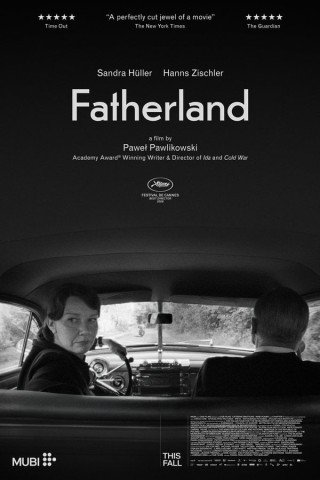
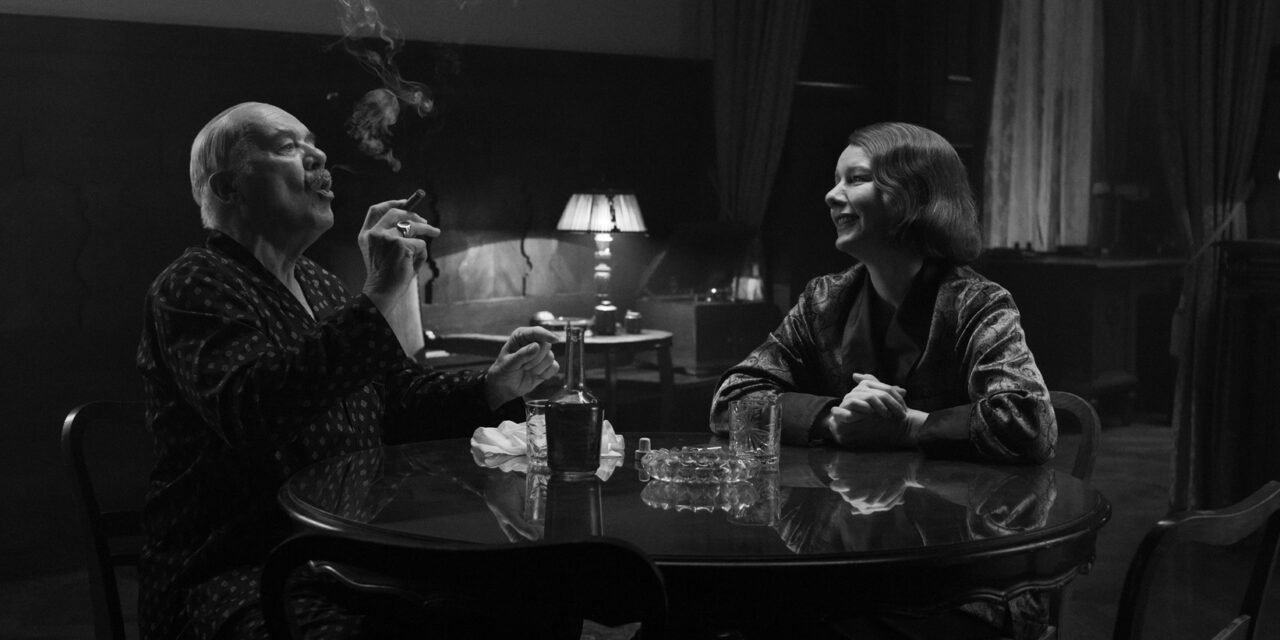
Imagine the disillusionment of being honored for your accomplishments only to find out that those accolades are intrinsically insincere, an attempt to tap into your public recognition as a means to win over your tacit support in a battle of wills between two powerful forces. Are your achievements being praised for their merits, or are they being exploited simply to help fulfill another’s agenda? And would you rightly feel that your reputation had somehow been cheapened or tarnished in the process? If you can appreciate the sadness, frustration and disappointment such circumstances would engender, then you should be able to appreciate the feelings they evoked in an acclaimed novelist upon what was supposed to be his triumphant return home to his native Germany at the end of World War II, the focus of the new biographical drama, “Fatherland” (“Ojczyznz”) (web site, trailer).
In 1949, 16 years after fleeing his homeland with the rise of fascism, accomplished author Thomas Mann (1875-1955) (Hanns Zischler) returned to his roots as part of the 200th birthday celebration of Johann Wolfgang von Goethe (1749-1832), considered by many to be Germany’s most influential author. Goethe believed, as did Mann in his footsteps, in the transcendent nature of Germanic culture, a notion that arose at a time when the future-unified nation was still fractured into an array of small independent states. Mann adhered dearly to Goethe’s vision, a concept he believed to be critical after the war, when Germany was carved in two – West Germany, under the control of the US, Britain and France, and East Germany, under the control of the Soviet Union. This division thus placed “the new Germany” at the forefront of the emerging Cold War, a political and ideological battle for the hearts and minds of two opposing viewpoints, the democracy of the West and the Communism of the East. This separation troubled Mann greatly, and he hoped to fly above it, focusing on the poetic eloquence that Goethe espoused. But, as became quickly apparent, that would be easier said than done.
Mann, who had been living in the US for years, was scheduled to make two stops on his trip, one in Frankfurt am Main in the West, Goethe’s birthplace, and one in Weimar in the East, where he spent much of his life. He was slated to make a speech at each stop, where the American and Soviet ruling forces sought to play off his distinguished reputation in courting his support for their respective visions of the new Germany, a prospect that flew in the face of Mann’s hope for a transcendently unified nation. In fact, as one of Mann’s hosts cynically put it upon his arrival in Frankfurt, he was now being backed into a corner of having to choose between “Mickey Mouse or Stalin.”
To complicate matters, while attending a reception on his trip’s first stop, Mann was approached by Wieland and Wolfgang Wagner (Enno Trebs, Theo Trebs, respectively), the grandsons of composer Richard Wagner (1813-1883), a cherished favorite of Nazi Chancellor Adolf Hitler, who drew upon the composer’s works as a source of inspiration for his vision of the Fatherland. The younger Wagners were eager to court Mann to support the restoration of a revisionist vision for Germany, one rooted in the country’s recent prewar past and influenced by their grandfather’s music. In doing so, they also politely reminded Mann that his early literary works were said to be inspired by their grandfather’s repertoire. Mann, in turn, didn’t hesitate to remind the brothers of what the Third Reich did in appropriating their relative’s works – and that he had no love for how his music had come to be regarded or to offer any support for a return to the extremist views with which it had become associated.
Accompanying Mann on his trip was his daughter and aide, Erika (Sandra Hüller), who diligently looked after her father’s professional and personal needs. This was not an easy task given his advanced age, the pain of a recent tragedy involving his son, Klaus (August Diehl), and the pressures being put upon him to make him a pawn in this high-stakes geopolitical game. He believed that he could fly above these ordeals by taking the high road intellectually and practically, but he was in denial of the agony of the losses involved and how he was being manipulated by others (some of whom were quietly and innately opposed to Mann and his sometimes-unpopular sentiments), truths to which Erika desperately tried to enlighten him. Their trip together, then, was one of reconciliation and acceptance of these conditions. But, considering the stakes involved professionally and personally, would Mann be up to the challenges they posed?
After leaving Frankfurt, Mann and his daughter traveled to Germany’s Eastern Sector for their stop in Weimar. But, as happened in Frankfurt, they were again subjected to the same kind of genial arm-twisting that they experienced in the west, most notably by Eastern Bloc officials Major General Sergei Ivanovich Tulpanov (Daniel Wagner) and Johannes Becher (Devid Striesow). And, sadly, by this point, Mann’s disillusionment began to set in, seeing his worst fears confirmed and his hopes for the new Germany in Goethe’s image being dashed before his eyes.
Based on the foregoing, Thomas Mann was in a decidedly unenviable position. Being caught between two powerful ideological perspectives (three if one counts the viewpoint of the Wagner brothers), he was being pulled in opposite directions as he watched his own dream for the future of a new Germany vanishing before him. One might think he didn’t know what to believe given these strong-arm tactics, but he actually had a clear vision for, and strong belief in, what he wanted, no matter how roundly it was disappearing. And, to his credit, that’s crucial in light of the role that our beliefs play in the manifestation of our existence (especially in its preferred form), the philosophy that makes such outcomes possible. It’s unclear whether he had ever heard of this school of thought, but, given the strength of his convictions, he clearly knew what he wanted, despite the pressure being put upon him by outside sources. The question here, of course, was, could it indeed be brought into reality?
As one watches this film, however, there’s a pervasive sadness to its narrative. In 1949, there should have been cause for hopefulness, optimism and celebration, a time when the war was finally over and the rebuilding process was under way. Yet those considerations were ultimately secondary, giving way to the agendas of the “victors” in the conflict, namely, who would get the bigger foothold in Europe, particularly in Germany. In many regards, those adhering to that belief ran roughshod over enlightened thinkers like Mann, who saw these circumstances as being an opportunity to launch a new Germanic renaissance, one rooted in its rich cultural and artistic traditions, the kind of society that Goethe envisioned but that was politely seen as superfluous by policy makers.
As time passed, though, Mann could see that his disillusionment was getting the better of him, and his beliefs behind his vision weren’t strong enough to overcome the opposition. His supposedly triumphant return home after so many years away was turning to sorrow, and there was little he could do to stop it. While it’s true that a unified Germany would once again reappear many years later, it still wasn’t (and isn’t) the nation he sought to bring into being. Old grudges and disagreements remained – some of which were spawned in the post-war era – even when the country was later reunited under a single flag.
“Fatherland” thus presents viewers with a reality check when it comes to our beliefs and how they’re deployed to produce the outcomes we seek. It can be quite a trying exercise, as this picture so aptly illustrates. And it makes one wonder whether anything can realistically be done when events don’t materialize as planned..
Guarantees under conditions like this may be formidable, if not impossible, to secure. But this doesn’t mean one should give up the ship. As recent experiences have shown us, fundamental change is possible with sufficient belief support behind it. It also means not giving in to undercutting beliefs like fear, doubt and contradiction, notions that are sure to lead to failure and disappointment. Dreams may be dashed in the short term, but that doesn’t mean the change must be permanent. Remember, when Pandora’s box was opened and all of the furies escaped, there was also one that remained after their departure – hope. That might not be a lot to hold onto, but it’s better than nothing, especially when it works its magic in bringing visionary ideas into existence.
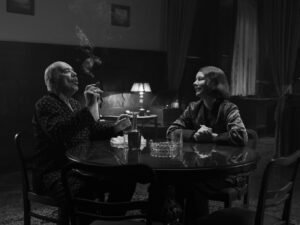
This fact-based version of Mann’s odyssey is a quietly moving exploration of how to reconcile one’s feelings and beliefs about circumstances over which one has little control, to earnestly (albeit painstakingly) try to fly above the fray when persistently being tugged at from forces below. Admittedly, there’s an innate sorrow hanging over the duo’s journey, one associated with feelings of loss over what’s gone and never likely to return. The regrets stemming from this almost made Mann and his daughter wonder whether ending the conflict only created new and potentially bigger problems to be solved – and with all of this coming on top of personal anguish as well. While the film probably could have used a little more back story to supplement its scant 1:22:00 runtime and to enlighten viewers unfamiliar with the material, “Fatherland” is otherwise one of this year’s best releases, featuring outstanding performances by Zischler and Hüller, as well as its gorgeous and fittingly metaphorical black-and-white cinematography, one of the filmmaker’s signature aesthetic hallmarks. For its efforts, the picture earned two nominations at the 2026 Cannes Film Festival, including a win for Pawel Pawlikowski as best director, with more awards season accolades likely to come – and deservedly so. The film is currently playing theatrically.
Disappointment is one of those emotions that’s difficult to process. It’s a setback from which it can be hard to rebound. But, like failure, it can also be a valuable teacher, showing us where things went awry and, possibly, how to bounce back. It also enables us to give ourselves permission to grieve when plans don’t work out, a necessary element to eliminate if we ever hope to make a comeback. This is one of those situations where we should be thankful for what we learn from the experience so that we don’t make the same mistakes when starting over. And that’s essential if we ever hope to see our dreams realized rather than dashed.
A complete review is available by clicking here.
Wrapping Up the Chicago Film Festival

The 62nd annual edition of the Chicago International Film Festival is now in the books, having featured an array of narrative, documentary and short films. In all, I managed to catch 17 films during the festival’s 11-day run. A full review of “Fatherland” appears above, and full reviews of two other features – “Elsinore” and “Bunker” – will appear in a future edition of Movies with Meaning. In addition, a wrap-up of the rest of my screenings from this year’s event can be found by clicking here, with audio reviews of three titles from the festival available here. Enjoy!
Adhering to One’s Convictions
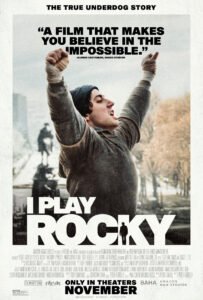
Sticking to one’s convictions can be challenging, but it can also pay big dividends. Others may not agree with such dogged fortitude, seeing the supreme confidence and unwavering certainty associated with it as a form of unreasonable stubbornness, a sure sign one has embarked on a fool’s errand. And, in some cases, that might actually be true. But, when we firmly believe in ourselves and our beliefs, there’s no telling what we might accomplish. So it was for a little-known aspiring writer-actor in 1976, when he envisioned himself playing the title role in a film he penned himself, an underdog tale that many saw as a longshot, as depicted in this fact-based story behind the making of one of Hollywood’s most enduring movies and the franchise that arose from it, the entertaining and inspiring new back story biopic, “I Play Rocky” (web site, trailer).
In the early 1970s, Hollywood icon Sylvester Stallone (Anthony Ippolito) was a struggling actor in New York. He attended many auditions but only managed to land bit parts in obscure movies, often typecast in the role of thugs and heavies. He was desperate to eke out a living, taking a variety of odd jobs and even starring in an adult film to raise money. But his career prospects were basically going nowhere fast. And this was a subject he was frequently lectured about by his demanding, overbearing father, Frank (Matt Dillon).
However, Stallone was not deterred by these setbacks. And his fortunes began to change when he took a job as a ticket taker at a New York moviehouse. It was there that he met Sasha (AnnaSophia Robb), a box office attendant to whom he took a strong liking. Even though she was slow to warm up to his advances, she eventually fell for her co-worker. But, romantic considerations aside, Sasha’s greatest contribution to his life was as a source of inspiration. She could see that he was struggling in his career and frustrated with the few unsatisfying roles he was getting. So, to compensate for this, she suggested that, if he was displeased with the opportunities coming his way, he should try an alternative approach – by writing the kinds of roles that he wanted to play. He hadn’t previously given much thought to the idea of becoming a screenwriter, but, he asked himself, “What do I have to lose?”
Roughly 18 months later, after honing his craft by composing a number of preliminary scripts, the couple moved to Los Angeles, a better venue for pursuing acting opportunities, pitching screenplay projects and making industry connections. And, not long after arriving on the Coast, he managed to swing a meeting with producers Irwin Winkler (P.J. Byrne) and Robert Chartoff (Toby Kebbell). Their initial get-together didn’t yield any substantive results, but it was a foot in the door that led to subsequent meetings. He eventually pitched them on a script for an inspiring underdog tale about an aspiring boxer who unexpectedly gets a shot at the big time, the saga of Rocky Balboa.
Stallone wrote the script in only 3½ days, feverishly turning out pages as if he were channeling it into being. Winkler and Chartoff were thrilled with the results, and they were extremely enthusiastic about turning the project into a film. But the producing duo was less than eager to grant Stallone’s condition for acquiring the rights to the story – that he be allowed to play the lead in the movie.
Winkler and Chartoff, backed with the zealous concurrence of their jittery financier, Sandy Maddox (a fictional composite character played by Tracy Letts), wanted a bankable star to portray Rocky, but that wasn’t Stallone. While it’s true that his visibility began to grow when he moved to Hollywood, most viewers hadn’t seen or even heard of the two features for which he had gained the most recognition, “The Lords of Flatbush” (1974), a low-budget independent film, and “Death Race 2000” (1975), a campy, obscure Roger Corman production. To overcome Stallone’s condition, Winkler, Chartoff and Maddox repeatedly raised the writing fee, sweetening the pot in hopes that Stallone would take the money and back down from his demand. However, he held firm to his intent to play Rocky, contending that his character’s story was, in many respects, his own story, that it was a personal quest and not just another movie role.

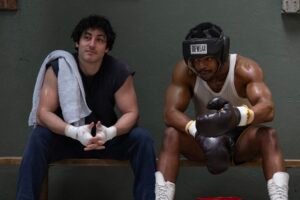
In the end, the producers gave in to Stallone’s demands when they realized the picture would never get made if they didn’t capitulate. However, in agreeing to their terms, Stallone gave up a huge sum of cash. Also, according to the terms of the production financing agreements, Winkler, Chartoff and Stallone would have to pull off a miracle to get the picture shot on time and on budget, circumstances that called for complying with a boatload of logistical considerations. This meant sticking to a nearly impossible shooting schedule that didn’t make allowances for multiple takes. It also meant relocating the setting of the story from New York to Philadelphia to avoid union labor issues. And, of course, there were plenty of huge hurdles to overcome, such as Stallone having to learn how to box, an enormous undertaking for a movie about a prize fighter.
Given these daunting conditions, could this project realistically be pulled off? That’s what Stallone, the producers, and hard-nosed, no-nonsense director John Avildsen (Jay Duplass) would find out when they got to the City of Brotherly Love. And that’s what this film does – showing viewers how they did it.
Of course, as is plainly apparent in both this film and the predecessor on which it’s based, beliefs are at the core of what made their respective productions work, and numerous individuals contributed to that result. So what kinds of beliefs were involved and why are they so important? That’s because of the role they play in manifesting the reality we experience, the philosophy that makes such outcomes possible. It’s impossible to say if any of the parties in either picture have or had ever heard of this school of thought, but, based on what the characters, casts and crews in these stories say and do, it’s obvious they recognize and believe in the power of these resources in transforming the intangible into the tangible. And what results they managed to bring into being.
In this film, for example, it’s clear that Stallone fiercely believed in the veracity of this project and in himself. Given how quickly he wrote the screenplay and how supremely satisfied he and the producers were with the finished product, it’s impossible to deny that their beliefs in the story and script were solid through and through. And, with that kind of validation behind those elements, it’s almost unthinkable that the project wouldn’t get the green light.
In a similar vein, the same could be said for Stallone’s belief in his confidence to play the lead. Why? This was his baby, a project into which he poured his heart, soul and being. It was also an expression of who he was, so who better to play him than him? And, he was so convinced of this notion – and believed in it so strongly – that he put himself on the line, passing up lucrative deals to step aside and just accept the script fee rather than hold out for a shot at the lead role, a prospect that Winkler and Chartoff were initially dead set against and that Maddox was opposed to all through the production process and right up until the movie’s premiere.
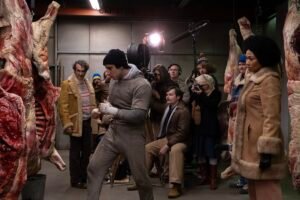
One might naturally ask how “Rocky” thus managed to survive – and thrive – in the wake of this onslaught of negativity. Again, it was a question of beliefs – and, specifically, the power behind them. Stallone’s belief in the project in all its aspects was so formidable that the naysayers ultimately were unable to muster enough clout to see their aspirations fulfilled and the production’s creator to be undercut by their doubts and criticisms. In particular, Stallone’s faith and inspiration – both of them forms of belief – were simply too impressive to be squelched. And the proof of that, as they say, can be found in the pudding, in terms of box office, crowd reaction, enduring popularity and the emergence of a successful movie franchise that has lasted for 50 years.
In many respects, “Rocky” was also an unstoppable juggernaut once in production, more proof of the power of the beliefs driving it. For instance, whenever problems appeared during the film’s shooting, workarounds to these thorny issues always somehow managed to emerge and with profoundly effective impact, no matter how unlikely any solutions might have seemed to initially be. In fact, even when seemingly intentional opt-out clauses were built into the production financing agreements, their exercise and implementation were always thwarted, even at some of the most dire points in the picture’s filming. It’s as if the belief backing of those involved in the picture was so strong that the project took on a life of its own and could not be killed. And, if that doesn’t demonstrate the power of beliefs, I don’t know what does.
“I Play Rocky” brings all of the foregoing to light. And, ironically, the intangible resources that made the original film possible would appear to have trickled down and infused themselves here. Viewers can feel the inspiration and gumption of the predecessor’s creators in this project, almost as if the legacy of “Rocky” was being lovingly passed down to its progeny. Undoubtedly this offering didn’t face some of the same financial and logistical obstacles that impacted its predecessor, and it had the benefit of built-in recognition that the first film lacked, but the “can do” spirit that made “Rocky” work so well can be seen reflected here. And, because of that, this release makes even clearer the uplifting message of its parent, a workshop not only in the field of boxing, but also in terms of succeeding at an ambitious undertaking, no matter what field of endeavor might be involved, one that we can all draw from in tackling our respective ventures.
Whoever thought that a “making of” movie would turn out better than the picture whose production it was chronicling? Well, maybe this isn’t a bona fide “making of” film in the strictest sense of the term, but the intent is essentially the same. Director Peter Farrelly’s latest outing offers a fact-based interpretation of the behind-the-scenes story of the filming of “Rocky,” a shoestring budget saga featuring a script and performance by a little-known talent. In the end, though, this offering about the filming of an unexpected box office sensation provides viewers with an inside look at the cinematic phenomenon. That underdog release ultimately captured 10 Oscar nominations, winning three awards (best picture, director and film editing), and made the career of actor-writer Stallone, who was nominated in both capacities, the first individual to do so since Orson Welles.
In addition to the foregoing elements, this entertaining comedy-drama also features fitting homages to the actors who created memorable characters in the original, including Carl Weathers (Stephan James), Burgess Meredith (Robert Morgan), Burt Young (Scot Teller) and Talia Shire (Kiki Seto). It also shows how the people who had tremendous impact in Stallone’s personal life, such as his supportive wife and hypercritical father, became reflected in the characters of the original film’s script.

So how do things turn out in the end? You’ll just have to watch both movies for yourself to find out (that is, if you don’t already know how they end up in the original). Surprisingly, though, perhaps the quality I found most intriguing about “I Play Rocky” is how much better it makes its predecessor look than it actually is. In the interest of full disclosure (and what is likely to be seen as an extremely unpopular opinion), I’m not an overly enthusiastic fan of the original (I find it somewhat clichéd and did so at the time of its debut). But this release takes what’s best from “Rocky” and plays to those strengths here, a tale of inspiration, following one’s dreams and adhering to one’s personal truth, both for the title character and his real-life creator. Because of that, audiences are likely to see this offering as a crowd-pleasing feel-good movie, and, for the most part, justifiably so.
To be sure, “I Play Rocky” could stand some modest improvement in spots, such as the editing and pacing of its somewhat overlong opening hour, the acting quality of Ippolito’s initial scenes (despite an otherwise-fine performance subsequently), the exaggeration of Stallone’s allegedly unknown acting status at the time he launched into the project, and, frankly, a less-than-compelling (though ultimately understandable) title. But these minor shortcomings are compensated for by its many other fine attributes, such as the performances of an excellent ensemble, its faithful cinematic authenticity in re-creating well-known material from the original, a well-penned script (especially in some of its hilarious comic relief), and, of course, its wisdom in emphasizing what made both this film and its predecessor work best. “I Play Rocky” might not qualify as groundbreaking cinema, but it’s certainly a highly entertaining and inspiring time at the movies. The picture is currently playing theatrically.
Most of us would likely agree that it’s gratifying to see when the good guys win, no matter how that notion is ultimately interpreted. That can certainly be said about the off-screen story of how this offering’s predecessor came into being, as well as this chronicle of that venture. But that’s not surprising, though, when one considers the enlightening message underlying both pictures. It’s something that we can all tap into in our own lives, too, turning each one of us into an embodiment of its inspirational source. And there’s nothing “rocky” about that.
A complete review is available by clicking here.
Copyright © 2026, by Brent Marchant. All rights reserved.


