
Rediscovering One’s Calling
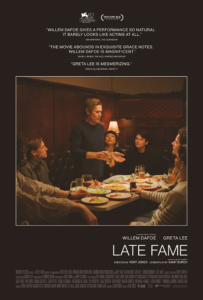
Well-meaning optimists often nudge us to believe that it’s never too late to discover (or rediscover) our respective callings in life (and sometimes they’re right). At a time when many of us may have given up on our dreams or settled for a less complicated way of life, there are those who may nevertheless eagerly follow such inspirational advice and find the experience refreshingly rejuvenating. But, even with the best of hopes and intentions, what’s the guarantee, if any, of success at such undertakings? Those are among the themes explored in the new dramatic character study, “Late Fame” (web site, trailer).
In many regards, the foregoing aptly describes the life of Ed Saxberger (Willem Dafoe), a longtime postal worker nearing retirement who, at one time in his youth, was admired as a gifted aspiring poet in the 1970s New York arts scene. The 17-year-old high school dropout from western Pennsylvania moved to the Big Apple in 1979 to find his destiny and subsequently rose to prominence in a vocation that he never saw coming. But, over time, this creative venture faded, and he settled into a quiet life of relative seclusion, his published works essentially vanishing into obscurity.
However, a chance meeting later in life holds the potential for changing everything. Fast forward to the present day, when Ed meets Meyers (Edmund Donovan), a fawning twenty-something fan of Saxberger’s now-virtually unknown works. Meyers acts as the de facto head of a creative circle of socially and financially privileged peers who regularly meet at an edgy downtown Manhattan coffeehouse. Like Meyers, the group’s other members mostly refer to themselves by their last names, including Broussard (Clay Singer), Carmichael (Arthur Langlie), Sherfey (Graham Campbell) and Winn (Luca Padovan), among others. These self-proclaimed seekers of artistic integrity and ardent foes of society’s addiction to brain-rotting technology see themselves as radical, if not uncompromising activists for their cause. They’re harsh critics of those who aren’t as obsessively committed to their respective crafts as they are, particularly the many self-anointed social media influencers and cluelessly oblivious posers who surround them, individuals whom they see as pale echoes of artists of years gone by.

In many of the group’s gatherings, Meyers has extensively talked up his idol’s rediscovered works to his rapt colleagues, and, because of his advocacy for Saxberger’s writings, he pleads with Ed to meet them at one of their sessions. Saxberger is initially reluctant, humbly confessing that his poetic phase was a long time ago, almost in another lifetime. But, thanks to Meyers’ aggressive coaxing, he begrudgingly agrees to the invitation.
Saxberger quickly finds that these surprisingly zealous disciples want to do whatever they can to resurrect his career, a proposal that leaves him simultaneously overwhelmed but seduced. They discuss introducing him to an agent (Jake Lacy) and setting up a reading for poets, authors and performance artists like those that were common back in the day when Ed was actively pursuing his calling. They even ask him if he would consider writing and reading a new work at the event, a challenge he finds daunting but intriguing. And, consequently, the seduction is so strong that he can’t help but agree.
As he begins work on the new piece, Saxberger soon finds himself ensconced in a different kind of seduction as well – the advances of another group member, Gloria (Greta Lee). As the somewhat mysterious nonconformist of the group, unlike her peers, she’s one member who doesn’t follow suit and go by her last name. This middle-aged, flirtatious actress-chanteuse less than subtly makes eyes for Ed, not unlike what she’s supposedly already done for a number of other circle members. Saxberger clearly goes for this kind of attention, too, something that he apparently has not experienced for some time.
But is Ed ready for all of this newfound adoration? Can he really recapture his past? Is he up to the task and what comes with it? And are Meyers and company everything they appear to be? Those are the challenges put to the protagonist to sort out as he enters this unexpected phase of his life.

Those who have been out of circulation for a while may well jump at the chance for what’s being offered them under circumstances like these. While it’s true that they might have skeptically looked upon a comeback as a long shot after many years, that’s not to say it’s out of the realm of possibility, especially if conditions seem legitimate to make it happen. The key question that arises at this point, then, is, what does one believe? That’s crucial considering the role that our beliefs play in the manifestation of our existence, the philosophy that makes such outcomes possible. It’s unclear whether Saxberger has ever heard of this school of thought, but, given his track record, he has demonstrated to himself and others that he can employ its principles to make things happen that he didn’t at one time expect. Given that, is it unrealistic to consider its recurrence? Indeed, if this were a case of something walking like a duck and talking like a duck, what would you do? And, in light of that, is there any obvious reason why Ed should do any differently? He seems convinced that proceeding along such a course is indeed valid (its unexpected qualities notwithstanding), so why shouldn’t he do so?
In pursuing such a course, however, it’s imperative that one is convinced and committed to it. Ed certainly possessed those qualities during his initial foray into writing poetry, but does he now? After all, when he first meets Meyers, he acknowledges that his poetry days were a long time ago. Some might see this as a confession that he no longer has the skills or that new or returning ventures like this are no longer possible with the onset of age. At the same time, though, this could also be an offhand acknowledgment of simply being rusty or out of practice. In either case, however, the underlying determiner is Ed’s beliefs about this prospect. And that, of course, will be determined by whatever selection of beliefs he chooses to embrace.
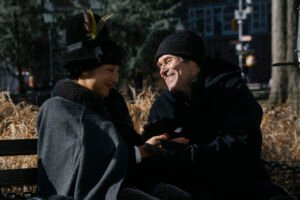
In deciding which beliefs to grasp, it’s important to look at those that can undercut one’s intentions. Generally speaking, fear, doubt and contradiction are those that can cause the greatest concern. The reason is that they can negate whatever other beliefs one might hold, keeping manifestations from materializing when expected or at all. These undermining beliefs, in turn, can also take on lives of their own if they’re allowed to get a foothold in our consciousness, snowballing into unstoppable juggernauts that can lead to frustration and failure, no matter what other positive conditions might be present. And eliminating them – even over the long run – may be nearly impossible.
It’s important to be realistic about the chances of success in scenarios like this, which, of course, means being honest and authentic with oneself. On the one hand, it’s possible that one might decide that there’s more to be said and done with the time one has left. On the other hand, though, such a bold undertaking as this might not be seen as worth pursuing, that it represents a part of one’s life that’s no longer relevant or that could require more effort than what one would be willing or able to expend. No matter what the decision, these are all scenarios that ultimately are driven by the beliefs that underlie them, and only we can decide which choices are best for us.
There’s also the impact of outside considerations to be taken into account. In this instance, is Ed moving ahead with his plan because it’s what he wants or what others want? Given Meyers’ gushing fan worship, it may be difficult for Saxberger to say no – another belief – or he might actually believe in his own self-worth and want to give himself another shot at the brass ring. Either way, this again brings up the question of being realistic, which, once more, only Ed can decide.
In some ways, this might sound like an exercise in overcoming ambiguity: On the one hand, an opportunity may seem like a good fit, while, on the other, it may not. And, to be honest, there likely are no definitive, universally true answers in a situation like this. Which is where the impact of our beliefs takes on even more importance in determining which decision to make. Let’s hope that Ed – and all of us – have the wisdom to see what course is best.

Based on the posthumously published novella of the same name by Austrian author Arthur Schnitzler (1862-1931), director Kent Jones’s contemporary version of this engaging character study examines the questions of can we get back what we think we’ve lost (i.e., so-called “late fame”) and what would we do with that recognition if it happens, especially if we’ve fundamentally changed in the interim. In answering these queries, the film explores an array of themes relevant to today’s conditions in the arts, in matters of legitimate integrity and authenticity, and in our willingness to embrace modern sensibilities and tangible trappings like ubiquitous technology. These rhetorical musings are effectively brought to life through the superb performances of the excellent ensemble (particularly Dafoe and Lee), the picture’s superb writing, its brisk, economical, no-nonsense pacing, and a fearless attitude in speaking its mind (an attitude not unexpected from a work by executive producer Martin Scorsese). While this offering could use a little more development in its back story, that only adds to the intrigue surrounding the protagonist’s mysterious background and unobtrusive disappearance, a minor shortcoming that’s easy to overlook.
“Late Fame” is a delicious indie surprise (now available for streaming) that eloquently addresses a subject generally given little attention. Perhaps this captured my appreciation because it’s a story to which I could personally relate in many ways. As a writer who rediscovered his own calling late in life, this title profoundly spoke to me, something that might not strike as many familiar chords with other viewers as it did for me. But, when it comes to tales of attempted comebacks, this is one of the best I’ve ever seen. And, in that sense, maybe it will have the same effect on you, even providing enough inspiration to prompt you to put down the cell phone and get up out of the easy chair while there’s still time enough left to do something truly fulfilling with your life, late fame notwithstanding.
A complete review is available by clicking here.
A Film Festival Wrap-up and Preview

The 44th annual edition of Chicago’s Reeling International LGBTQ+ Film Festival is now in the books, having featured an array of narrative, documentary and short films. The festival’s lineup was a big improvement over 2025, bringing in a slate of better programing compared to last year. In all, I managed to catch 13 films during the festival’s 11-day run, nine of which I rated good to excellent. A wrap-up of my screenings can be found by clicking here. In addition, audio reviews of three titles from the festival can be found here.

And, as one door closes, another opens! I’m pleased to announce that I have been selected to be part of the press corps for the 62nd Chicago International Film Festival. This is the second consecutive year in which I have been approved to cover the event. As in past years, I have an ambitious screening schedule ahead of me, so, if you’re in or will be visiting Chicago October 14-25, look for me at the festival’s primary screening venue, the AMC New City 14 Theaters. Look for my reviews during the event on the Quick Cuts page of my web site, with a full recap after the event.
Sometimes the Heroes Wear Masks
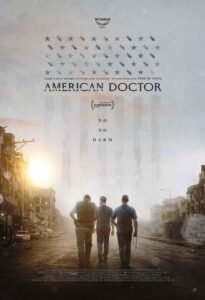

Few movies leave viewers lost for words, but director Poh Si Teng’s first full-feature documentary effort is one such film to do just that. “American Doctor” (web site, trailer) chronicles the experiences of three American physicians doing their part to treat the countless casualties wounded in Israel’s genocidal war with the Occupied Palestinian Territory of Gaza, a revelatory work from which it’s impossible to look away despite the shockingly barbaric events playing out on screen.
In telling this story, audiences are introduced to Dr. Mark Perlmutter, a Jewish orthopedic surgeon from North Carolina, Dr. Feroze Sidhwa, a Zoroastrian critical care surgeon from California, and Dr. Thaer Ahmad, a Palestinian emergency medicine physician and humanitarian activist from Illinois, in their efforts to make a difference in the health and well-being of Gaza residents. However, as soon becomes apparent, these intrepid healers are up against more than just caring for the physical maladies of the wounded. They face threats to their lives and safety in the wake of Israel’s relentless onslaught against Palestine, inflicting damage that utterly defies description – and believability.
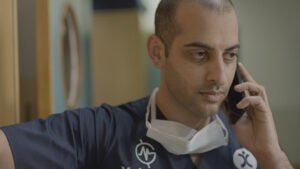
Of course, that’s if the physicians are even allowed to enter Gaza, given the avalanche of bureaucratic nightmares required for entry. Should they be allowed in, though, they must operate under conditions that are wholly inadequate to tend to the endless stream of injured, especially when hospital facilities are specifically being targeted for attack by the Israeli government, an unconscionable violation of Geneva Convention stipulations. They’re also left to treat an unspeakable number of pre-teen children who are intentionally inflicted with head and chest wounds – a number 600 times greater than what the youth of Ukraine face. And, if all that weren’t enough, physicians and other health care workers who dare speak out about such atrocities and deplorable working conditions often face deplorable hate speech attacks and professional retribution from medical organizations and government agencies, major threats to their careers simply for wanting to help make people well. All of which point to an underlying cause that has little to do with medicine and more to do with politics, specifically virtually unwavering support for the policies of the Israeli government and military, including by US officials.

Such circumstances inevitably take a personal toll on these dedicated individuals, too, so much so that they’re frequently wracked with guilt, leaving them asking, “Have we done enough?”, no matter how much they may have already done. It’s a truly damning indictment of those running things behind the scenes. In fact, if I were to make any improvements to this film, it would be in the editing, particularly the nonlinear timeline of the doctors’ experiences, but that’s a minor fault compared to the picture’s many other assets.
As noted previously, “American Doctor” can indeed be a difficult watch, given its often-graphic nature. But it’s also a necessary watch to see what’s really unfolding in Gaza, particularly its depictions of carnage that likely can’t be seen anywhere else except perhaps on alternative internet and social media sites. This is truly a probably – and eminently deserving – candidate for serious awards season consideration.
Words like “heartbreaking” and “infuriating” might well come to mind from viewing this release, and that’s a start to creating greater awareness. But that’s not likely to happen until more eyes are sufficiently opened – and that’s something this offering certainly does commendably with power, impact, and, above all, compassion.
Brotherly Love
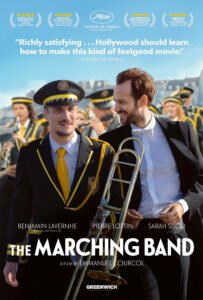
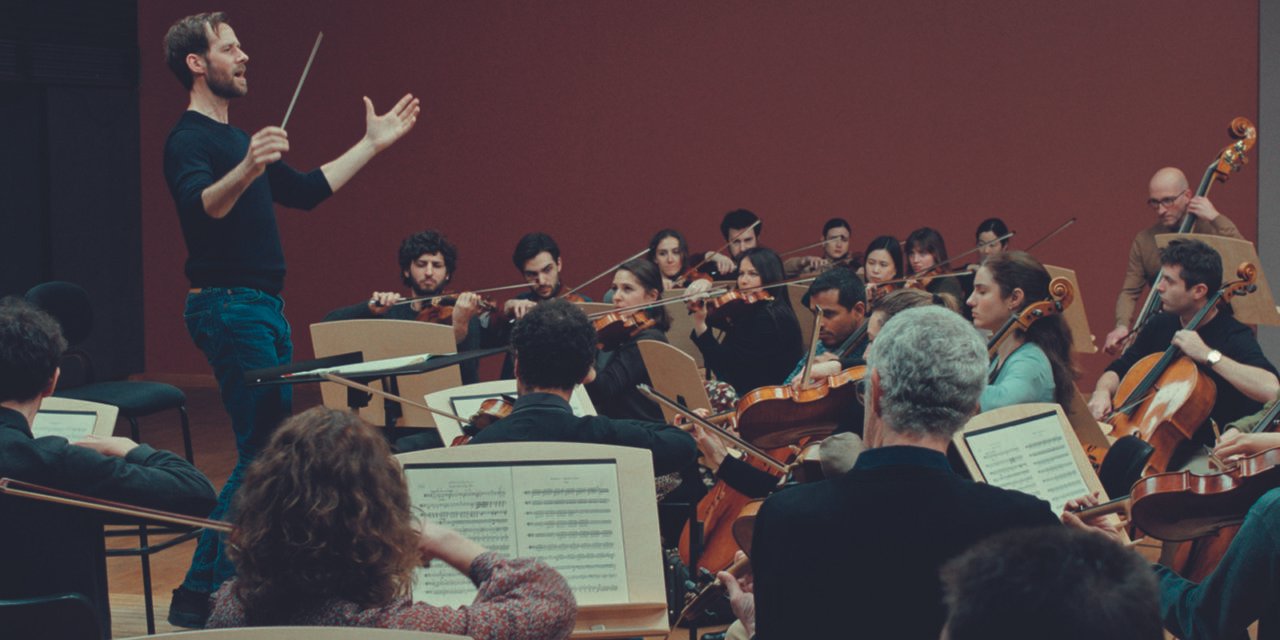
Fostering brotherly love isn’t always easy, especially when siblings are different from one another or, even more fundamentally, when they are unaware of one another’s very existence. But sometimes circumstances arise that break down these barriers and open up a new set of dynamics, providing an opportunity to put these conditions to the test to see what they might yield. Such is the case with two siblings long unknown to one another who are unexpectedly drawn together in a crisis in the heartwarming French comedy-drama, “The Marching Band” (“En Fanfare”) (web site, trailer).
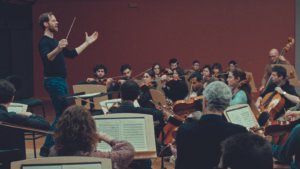
When famed orchestral conductor Thibaut Desormeaux (Benjamin Lavernhe) collapses during rehearsal, everyone is naturally concerned. After all, that’s not the sort of thing that’s supposed to happen to a seemingly healthy man in his thirties. But he soon learns that he has leukemia and requires a bone marrow transplant, a procedure in which the necessary donation material must come from someone who is a compatible match, most often a relative. Thibaut’s first choice for a donor is his sister, Rose (Mathilde Courcol-Rozès). However, when he learns the results of her screening test during a visit to his physician, he’s in for a pair of big surprises.
The first surprise is that Rose is not a match, and that’s because she is not Thibaut’s biological sibling, a fact about which he was completely unaware. It turns out that he was adopted, a secret that his mother (Ludmila Mikaël) had kept from him all these years. And, at first glance, that revelation would seemingly reduce his chances of finding a suitable donor, significantly diminishing his chances of survival.
Ironically enough, though, the first surprise leads to an even bigger second revelation: through a DNA database search, it’s found that Thibaut has a biological brother who he never knew existed. And, if a screening test proves positive, there’s hope for finding a suitable match. Of course, for that possibility to come true, he must first locate his sibling and convince him to go through a screening that might save a stranger’s life.
As it turns out, the long-lost mystery brother is nothing like Thibaut, as he discovers when the sophisticated Parisian pays a visit to his home in the more provincial city of Lille. Jimmy Lecocq (Pierre Lottin) is a blue collar cafeteria worker who leads a far more modest life than his renowned brother. Jimmy is naturally surprised at the news, but he’s also somewhat envious and angered by the revelation. Most notably, Jimmy feels that the siblings’ separation in their early years left him with the short end of the stick compared to how Thibaut fared. He believes his brother got the better end of the deal through their respective adoptions (talk about sibling rivalry). And now Jimmy wonders why someone who was involuntarily stuck with having to settle for less in life should go out of his way to help someone fundamentally more privileged. This embittered reaction leaves Thibaut wondering whether he’ll get the help he needs to survive.
Fortunately, Jimmy’s caretaker, Claudine (Clémence Massart), intervenes to smooth out circumstances between the newly united brothers. She appeals to Jimmy’s sense of compassion, which helps to soften his hard-edged attitude. And this change of heart is further bolstered when Thibaut and Jimmy discover they have a common bond to strengthen their connection: their mutual love of music. Thibaut’s conducting career is widely known, but, in Lille, Jimmy has developed quite a reputation as a virtuoso trombonist for the marching band of a local mining company, one that proudly takes part in organized performance competitions. With this common ground revelation, the ice between them melts, and Jimmy agrees to be screened. As hoped for, Jimmy is a suitable match, the procedure goes ahead, Thibaut is cured and the brothers forge a newfound relationship with one another.

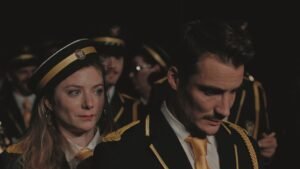
That connection comes in handy shortly thereafter when Jimmy learns he needs help. Not long before one of the band’s upcoming competitions, the group’s conductor (Antonin Lartaud) learns he is being transferred out of town. This leaves the band with no one on the podium to wave the wand. So, in gratitude for the favor that Jimmy granted him, Thibaut steps in to help Jimmy take over the conducting position, a role that he’s convinced his talented brother, who possesses perfect pitch, is more than qualified to assume. In fact, Thibaut is so impressed with Jimmy’s abilities that he does whatever he can to help him advance his career as a musician beyond just becoming the band’s new conductor.
However, is Jimmy ready for such a change? Can he truly step up to the position of prominence he once so greatly coveted when he first met his sibling? And can Thibaut genuinely help him in this quest? A number of distractions get in Jimmy’s way, too, such as the challenges of being a divorced father, the ups and downs of a potential romantic involvement with an adoring fellow band member, Sabrina (Sarah Suco), and the stresses of an ugly ongoing strike at the mining company that threatens the band’s future. But, if all this weren’t enough, an even bigger challenge awaits, one that could call everything into question.
The experience shared by Thibaut and Jimmy is remarkable on many levels. Who would have thought that the scenario would play out as it did considering how it began? But this illustrates how miracles can result, even in unlikely circumstances. What’s more, this is a situation where each character benefits from the results, not only from a personal standpoint, but also mutually, a case of not knowing what one is missing until it shows up. And to think it all comes about as a result of seemingly dire conditions, those that potentially could be viewed as having only a snowball’s chance of success at the outset.

So how did all of this come about? It’s a matter of belief and the power that these intangible resources carry, the philosophy that accounts for how our reality arises. On some level, Thibaut must have believed (at least subconsciously) that an unexpected outcome was possible, even after learning that his prime donor candidate was not going to work out. And, as for Jimmy, as someone who quietly but intently longed for his circumstances in life to turn out differently than they did, the particular line of probability that emerged likely wasn’t something he expected or, ostensibly, even wanted, yet somehow it had a way of working out for the best. As a result, not only do the brothers get what they’re looking for, but they also gain an unanticipated valuable new relationship with one another (again, you don’t know what’s missing until it shows up). It’s unclear whether Thibaut or Jimmy had heard of this school of thought going into this scenario, but they obviously had a handle on it at least in their consciousness given the results they wrought.
This is also a situation where the value of collaboration comes into play, an act of co-creation, where belief resources are pooled to evoke results that provide mutual benefits. And, in both cases, the outcome involves resolution to troubling circumstances – Thibaut receiving what he needed to address his leukemia and Jimmy getting what he wanted to overcome years of frustration and underwhelming results in life. The newfound friendship that surfaces is just icing on the cake (and what a cake).
Considering the magnitude of what each sibling gives one another, this film shows just what’s possible, even with seemingly impossible odds, when we have faith and believe in the manifestation of hoped-for outcomes. Moreover, considering the degree of generosity of spirit offered up by Jimmy and Thibaut, their actions and support for one another truly define the essence of brotherly love, not just as siblings, but as human beings helping out as Samaritans when the need arises. We can all learn much from their example, both in aiding our relations, as well as in assisting mankind in general when and where it’s needed most, regardless of what hindrances and unexpected developments might occur along the way and no matter how fate may play a hand, particularly when life or death is at stake.
Such are the themes characterizing the scenario in this tender comedy-drama from writer-director Emmanuel Courcol, a release that was a viewer and critically acclaimed box office sensation in the film’s native France. And for good reason – this warm, funny, touching tale makes for great crowd-pleasing viewing with its fine performances and profound chemistry between the two leads, as well as the contributions of its many colorful supporting players. It’s also a music lover’s delight, especially with its superb selection of classical works by the likes of Beethoven, Mozart, Verdi, Debussy, and, most notably, Ravel’s Bolero. Admittedly, the picture might be seen as having a few too many secondary story threads that aren’t always as fully developed as they might have been, sometimes slowing the pacing and causing the narrative to meander a bit. However, that aside, “The Marching Band” is a cinematic charmer that’s worth the time (and the cost of the box of tissues you should probably keep handy while screening). It’s truly gratifying when a movie hits all the right notes, and this one does a masterful job at achieving just that. The film is available for streaming online.
To some, the notion of brotherly love may seem a little sappy or old-fashioned. But, in an age where we could truly use more of this sentiment, this release serves as a helpful reminder of what we’ve lost sight and could stand to re-establish as part of our culture and everyday existence. Thibaut and Jimmy unapologetically place this before us, and they urge us not to downplay its importance in our lives, not just for our blood relatives but for all of us in humanity at large.
A complete review is available by clicking here.
Copyright © 2026, by Brent Marchant. All rights reserved.